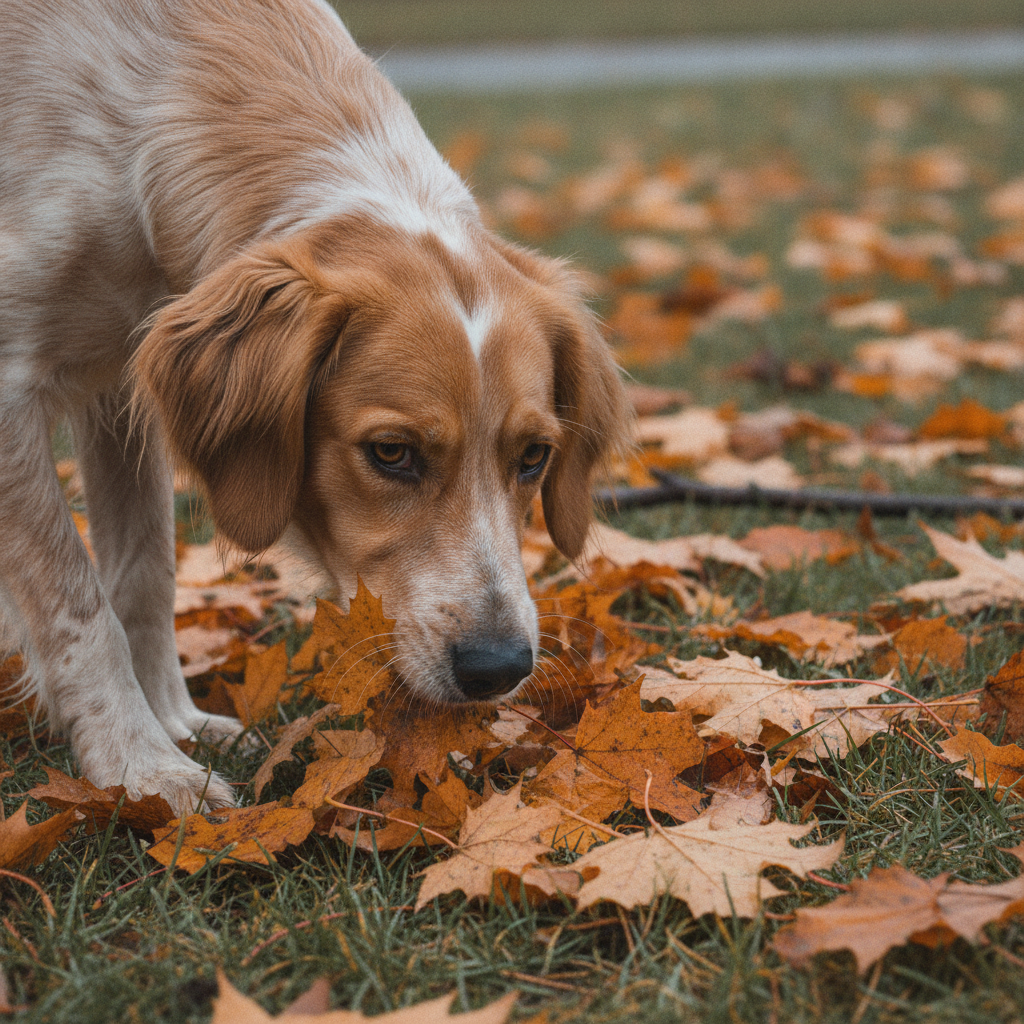
Take your dog out and watch what actually happens. You are scanning for cars, other dogs, the state of the sidewalk. Your dog stops dead at a patch of grass that looks like every other patch of grass and refuses to move. To you it is a delay. To them it is the day’s news, and they are only on the second paragraph.
Here is the reframing worth carrying around: your dog does not experience a slightly sharper version of your world. They experience a different world, one built out of information you cannot detect at all. We lead with our eyes. Dogs lead with their noses, and that single fact explains an enormous amount about how they behave, why they pull toward things you cannot perceive, and why a slow sniff-heavy stroll can leave a dog more satisfied than a fast walk twice as long.
Your dog has two kinds of smelling going on
Start with a distinction most people never make. There is passive smelling, which happens automatically every time your dog breathes, no effort required. Then there is sniffing, which is deliberate: those quick, rhythmic little intakes are your dog actively scanning the air for detail, the scent equivalent of leaning in to read fine print.
Watch closely and you may notice something stranger. Most dogs start a new smell with their right nostril and only switch to the left once they have decided the scent is familiar and safe. The likely reason is that the right side of the brain handles fresh, unclassified information, while the left leans on memory to figure out how to react to things already known. Scent is unusual among the senses here. Touch and most other inputs cross to the opposite side of the brain before being processed, but smell runs straight from one nostril to the same side’s brain. That direct wiring lets a dog react to a threatening odor fast, without the signal detouring across the brain first.
Dogs also carry a second scent organ you do not have. Tucked above the roof of the mouth sits the vomeronasal organ, which reads pheromones through tiny ducts just behind the upper front teeth. When a dog curls back their lip and freezes with a strange, gaping expression, often over another dog’s urine, they are not disgusted. They are opening those ducts to flood that organ with chemical signals about who was here and what state they were in.
The raw numbers are almost hard to believe
Follow a breath inward and the machinery comes into focus. Air enters the nostrils, moves through passages that warm it and strip out larger particles, and then splits. Most of it heads down to the lungs, but roughly one breath in eight peels off into a deeper chamber lined with olfactory tissue. That lining is packed with receptor cells, specialized neurons that fire when odor molecules lock onto them. The pattern and number that fire tell the brain both what the smell is and how strong it is. From there, signals travel the olfactory nerve to the olfactory bulb, a brain region that quiets background odors, sharpens anything new or threatening, and routes the rest to be matched against memory.
Now the comparison. A dog carries somewhere between 100 and 300 million of those receptor cells. You have around 5 to 6 million. Their olfactory bulb runs roughly three times the size of yours relative to the brain. This is not a small edge. It is a different order of instrument.
They smell across distance, and across time
Distance first. In fieldwork, dogs have picked up the scent of whale feces from more than a mile off across open water, a skill that turns out to be genuinely useful to researchers tracking whale health. How well any dog catches a scent depends heavily on conditions. Wind direction is usually the biggest factor, but humidity, fog, rain, and terrain all matter. A little moisture in the air actually helps carry scent particles to the nose, while hard rain can beat odors down toward the ground and make a trail harder to follow.
The stranger trick is time. A tracking dog can work out which direction a person walked by reading a scent trail from its faintest, oldest end toward its strongest, freshest one. Because odors fade on a predictable schedule, a dog reading how weak a smell has become is effectively reading how long ago something happened. That grass patch your dog will not leave holds a record of who passed through and roughly when, laid down over hours or days, that you walk over without noticing.
Humans are not as nose-blind as we were told
For a long time the textbook line was that people had a feeble sense of smell next to most mammals. That has not held up. Human olfaction turns out to be surprisingly capable despite our modest hardware, good enough to identify food, read social cues, and gather information about our surroundings. In one memorable 2007 study at UC Berkeley, blindfolded people with their ears blocked managed to locate and follow a scent trail by crawling and sniffing along the ground. They were slower than a dog, but they improved with practice, which suggests we could scent-track far better than we ever bother to try.
The real difference is reliance. Because a dog’s eyesight is less sharp than ours, they lean on scent for the things we handle by looking. It is their default channel, not their backup.
Yes, your dog knows you by smell
If the wind is right, your dog very likely smells you coming before they see you, freshly bathed or not. A 2015 brain-imaging study found that the reward-processing part of a dog’s brain lit up reliably when they caught the scent of a familiar person, the same region that activates in people looking at photos of loved ones. Other scents did not produce the same response. Your dog can also read emotional states off you, picking up whether you are calm, happy, or frightened from scent chemistry alone. That extra press against your leg on a bad day is not a coincidence. They can smell that something is off.
What that nose can be trained to do
Training does not make a dog smell better. The hardware is the hardware. What training does is teach a dog to treat a particular scent as worth reporting, and to tell a human when they have found it. A dog would smell a termite colony under a house with or without training, but termites are just bugs and structural integrity is not a dog concern, so they ignore it. Link that same smell to a reward and the dog becomes deeply invested in locating it.
Pointed at human problems, that ability does remarkable work:
- Medical alert. Service dogs trace back in modern form to the guide dogs that helped visually impaired veterans after World War I. Over time it became clear that scent-trained dogs could flag medical events too, including diabetic blood-sugar crises, certain cancers, epileptic seizures, COVID-19, and narcolepsy.
- Tracking and trailing. The bond between dogs and people is partly built on this: dogs that could follow game over long distances made hunting possible. The skill is mostly sport now in the US, but working trackers are still relied on elsewhere.
- Search and rescue. After floods, earthquakes, avalanches, and collapses, dogs cover large areas fast and pinpoint trapped people so rescuers can dig in the right spot.
- Recovery. Cadaver dogs do the hard, necessary work of locating human remains above ground, below it, or in water, giving families answers and closure.
- Conservation. Scientists send dogs to sniff out invasive species so control efforts can be measured, to catch crop parasites before an infestation spreads, and to find the droppings of endangered animals so populations can be tracked without disturbing them.
What’s new since this was written
The disease-detection work has taken a real leap. In July 2025, researchers with Medical Detection Dogs and the universities of Bristol and Manchester reported that trained dogs could identify Parkinson’s disease from skin swabs, correctly flagging people who had it up to 80 percent of the time and correctly clearing people who did not up to 98 percent of the time. Two dogs carried the study, a golden retriever named Bumper and a black Labrador named Peanut, trained on hundreds of samples. What makes it striking is that the odor appears on the skin years before obvious symptoms show up, which points toward much earlier diagnosis than we can manage now.
There has been movement on mental health too. A 2024 study found that dogs could detect the breath signature of a person reliving trauma, distinguishing a stressed state from a calm one with better than 80 percent accuracy. None of this replaces medical testing. But it keeps confirming the same thing: dogs are reading chemistry off our bodies that our best instruments still struggle to catch.
Age changes the nose, but does not switch it off
Like most senses, smell dulls with age. Older dogs have fewer working sensory cells in the scent-detecting region, and their olfactory bulb shows changes that resemble what is seen in the brains of people with Alzheimer’s. Humans go through something similar, usually starting in our seventies.
It is not all decline, though. A senior dog has spent a lifetime building a vast catalog of remembered smells, and they get better at sorting and distinguishing odors because of it. Even a dog whose raw sensitivity has faded still uses scent to explore and to recognize their favorite people. The practical takeaway: give an older dog time to sniff. It is enrichment, not dawdling. Just keep an eye out for any dropped food before they reach it, because a great nose has never stopped a dog from eating something regrettable.
When a smell problem is actually a health problem
Because scent is so central to a dog, losing it matters, and several conditions can dull or erase it, sometimes temporarily:
- Nasal cavity tumors
- Trauma to the nose or sinuses
- Canine distemper
- Viral, bacterial, or fungal upper respiratory infections
- Cushing’s disease
- Hypothyroidism
- Diabetes mellitus
- Allergies
- Brain tumors
Many of these dull smell only until the infection clears or the underlying issue is controlled. A dog who permanently loses their sense of smell can still live a full, happy life, but they may need time to lean harder on their other senses.
“People treat the nose like a fun fact about their dog, when it is really the main way the dog understands where they are and who has been around,” says Dr. Ravi Mehta. “If a dog who normally sniffs everything suddenly loses interest in scents, or the nose itself looks or acts wrong, I want to see them, because a change in smelling can be the first sign of something going on deeper.”
FAQ
Can a dog recognize its own scent? Yes. Dogs can distinguish their own smell from those of familiar and unfamiliar dogs, which helps them keep track of their own markings and read how other dogs have interacted with them.
Why does letting my dog sniff matter so much? Sniffing is your dog’s primary way of gathering information, so a sniff-heavy walk is more mentally satisfying and tiring than a fast one. Rushing them past every interesting spot takes away their main channel for understanding the world.
Why is my dog’s nose wet? Ordinary secretions, licking, and the surrounding air keep it damp, and dogs also release heat through the nose and paw pads. Moisture is not a health gauge, so do not read into a wet or dry nose either way.
References
- The Fluid Dynamics of Canine Olfaction: Unique Nasal Airflow Patterns as an Explanation of Macrosmia
- The Dog Nose “Knows” Fear: Asymmetric Nostril Use During Sniffing at Canine and Human Emotional Stimuli
- Faecal Sampling Using Detection Dogs to Study Reproduction and Health in North Atlantic Right Whales
- Poor Human Olfaction Is a 19th-Century Myth (McGann, Science 2017)
- Mechanisms of Scent-Tracking in Humans (Porter et al., Nature Neuroscience 2007)
- Scent of the Familiar: An fMRI Study of Canine Brain Responses to Familiar and Unfamiliar Human and Dog Odors
- Trained Dogs Can Detect the Odor of Parkinson’s Disease (Journal of Parkinson’s Disease, 2025)
- Age-Related Changes in the Olfactory System of Dogs
- Canine Olfaction: Physiology, Behavior, and Possibilities for Practical Applications