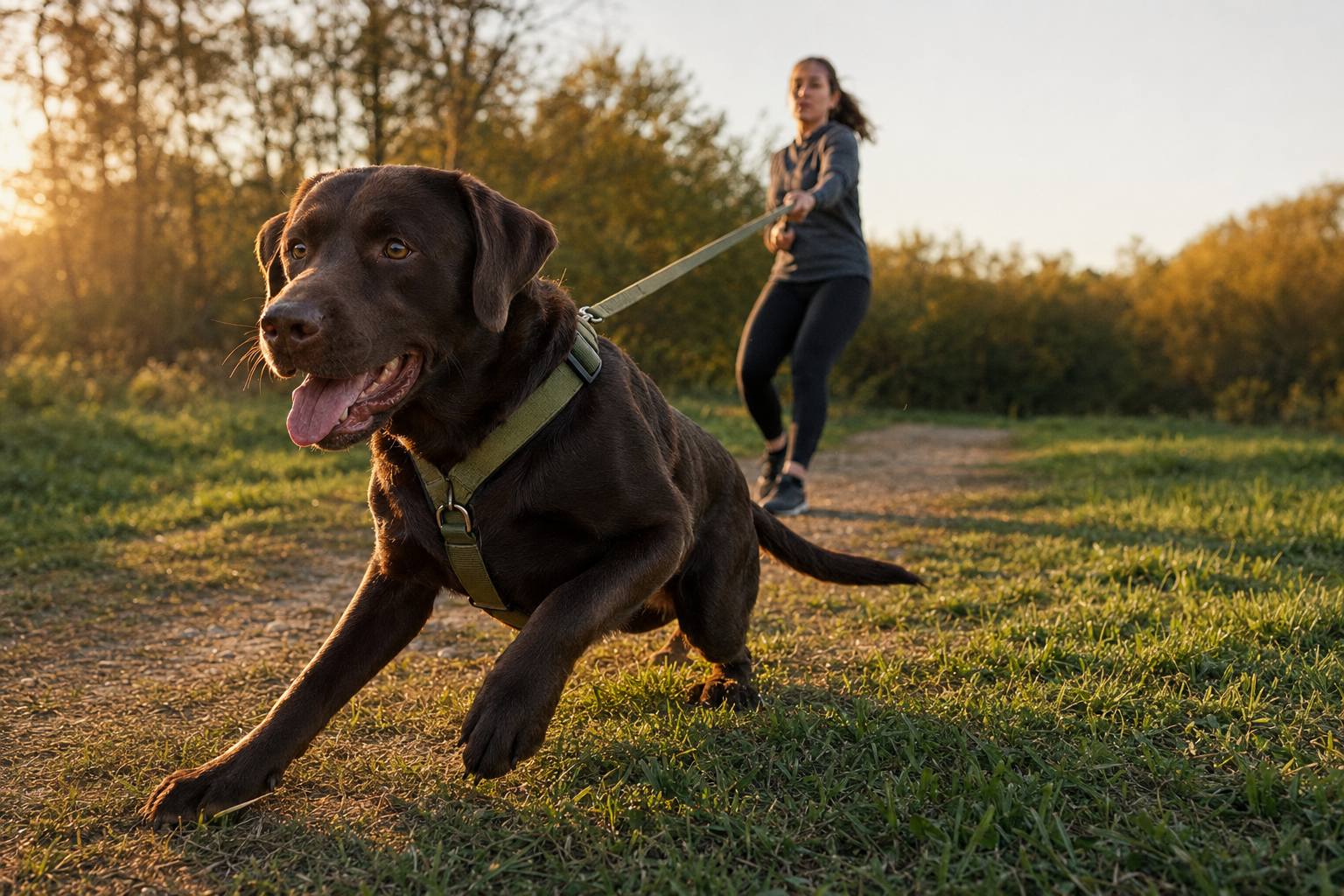
Here is the uncomfortable truth about a dog who drags you down the block: the walk itself is running the training program, and it is training the dog to pull. Every time the leash goes tight and you take a step forward anyway, the transaction clears. Tension earned progress. Your dog is not being stubborn or dominant. They are being paid, on a reliable schedule, by you.
That is actually good news, because transactions can be renegotiated. Fixing leash-pulling is less about teaching a fancy heel and more about changing what tension buys.
Why pulling feels so natural to them
Dogs come with a built-in quirk that trainers call the opposition reflex: apply steady pressure to a dog’s body and their nervous system answers by pushing back into it. It is the same reflex that lets sled dogs lean into a harness for miles. It means two things for your walk. First, a taut leash does not read to your dog as “stop,” it reads as something to lean against. Second, yanking back is worse than useless, because you are triggering the exact reflex you are trying to end, and adding stress that can curdle into leash reactivity over time.
Motivation matters too, and it splits into two very different dogs. One is pulling toward the world, jazzed to sniff everything and greet everyone. The other is pulling away from the world, overwhelmed and trying to escape it. The mechanics of the fix are similar, but the second dog needs the volume of the environment turned down first. If your dog is zig-zagging frantically rather than happily, start your training somewhere quiet and boring, and treat that as nonnegotiable.
The one rule that changes everything
If you adopt a single rule, make it this: a tight leash never buys forward motion again. When the leash goes taut, your feet stop. When the leash slackens, or your dog checks back in with you, the walk resumes. You are not punishing anything. You are changing the currency, so that slack is what pays.
Pair the rule with active hiring. Load a pouch with treats your dog would commit crimes for, and pay generously, at your side, every few steps at first. Do not worry about fading treats too early; you can thin the schedule once the habit is real. Time sessions before meals, when food motivation is highest, and start where your dog can actually think: a hallway, a yard, a dead-quiet street. Distractions are a dial, not a switch. Raise them gradually as the loose leash holds.
“People think they’re walking the dog and separately training the dog. There’s no separation. Every step you take while the leash is tight is a rep for the other team,” says Dr. Ravi Mehta.
Two habits to break in yourself, because both quietly pay the pulling: following a pulling dog with steady tension on the line, and choking up on the leash so the dog is permanently taut at your side. A short, tight leash guarantees constant pressure, which guarantees constant opposition reflex. Slack is the goal, and slack has to be possible.
Gear buys leverage, not results
For a strong dog, the right equipment keeps everyone safe while the training catches up. The point of gear is control through mechanics, never through pain.
A front-clip harness attaches the leash at the chest, ahead of the dog’s center of gravity, so a hard pull swings the dog’s body around instead of converting into forward drive. There is solid mechanical logic here and real welfare science behind ditching the neck collar for pullers: pressure studies have found that a hard-pulling dog on a flat collar can generate forces on the neck far above the threshold where tissue damage starts, which puts the trachea, thyroid, and even eye pressure in play. A harness spreads that load across the chest.
One honest caveat that gear marketing skips: researchers who study canine movement have found that some harness designs restrict shoulder extension and subtly change gait, and front-clip designs are among the suspects. For a healthy dog on daily walks this is a reasonable tradeoff against throat damage. For a canine athlete or a dog with orthopedic issues, ask your vet or a rehab professional about fit and design.
For the dog who improves but still launches at the occasional squirrel, a head halter adds steering the way a bridle steers a horse, through leverage on the head rather than pain. Most dogs need a slow, treat-heavy introduction before they will accept something on their snout, so budget desensitization time rather than strapping it on and hoping.
And keep gear in its lane: a harness or halter manages the symptom while training fixes the cause. The equipment cannot teach slack. Only the transaction can.
What newer research adds
The collar-versus-harness question has gone from opinion to data in the last few years. A 2021 study in Frontiers in Veterinary Science measured what actually happens when dogs hit the end of a leash on a neck collar versus a chest harness, part of a wave of research documenting how much force a pulling dog concentrates on the delicate structures of the throat. A 2025 review in the journal Animals pulled the field together and landed roughly where working trainers have: non-tightening front-clip harnesses offer the best current balance of comfort and pulling reduction, while aversive tools carry welfare costs that outlast the walk.
The same review is refreshingly blunt on the other side of the equation: no strap, clip, or halter replaces reinforcement. Gear changes the physics. Payment changes the dog.
References
- Shih, H.Y. et al. “Dog Pulling on the Leash: Effects of Restraint by a Neck Collar vs. a Chest Harness.” Frontiers in Veterinary Science 8 (2021): 735680.
- Lafuente, M.P. et al. “Effects of restrictive and non-restrictive harnesses on shoulder extension in dogs at walk and trot.” Veterinary Record 184,2 (2019): 64.
- “Review of Collars, Harnesses, and Head Collars for Walking Dogs.” Animals 15,15 (2025): 2162.