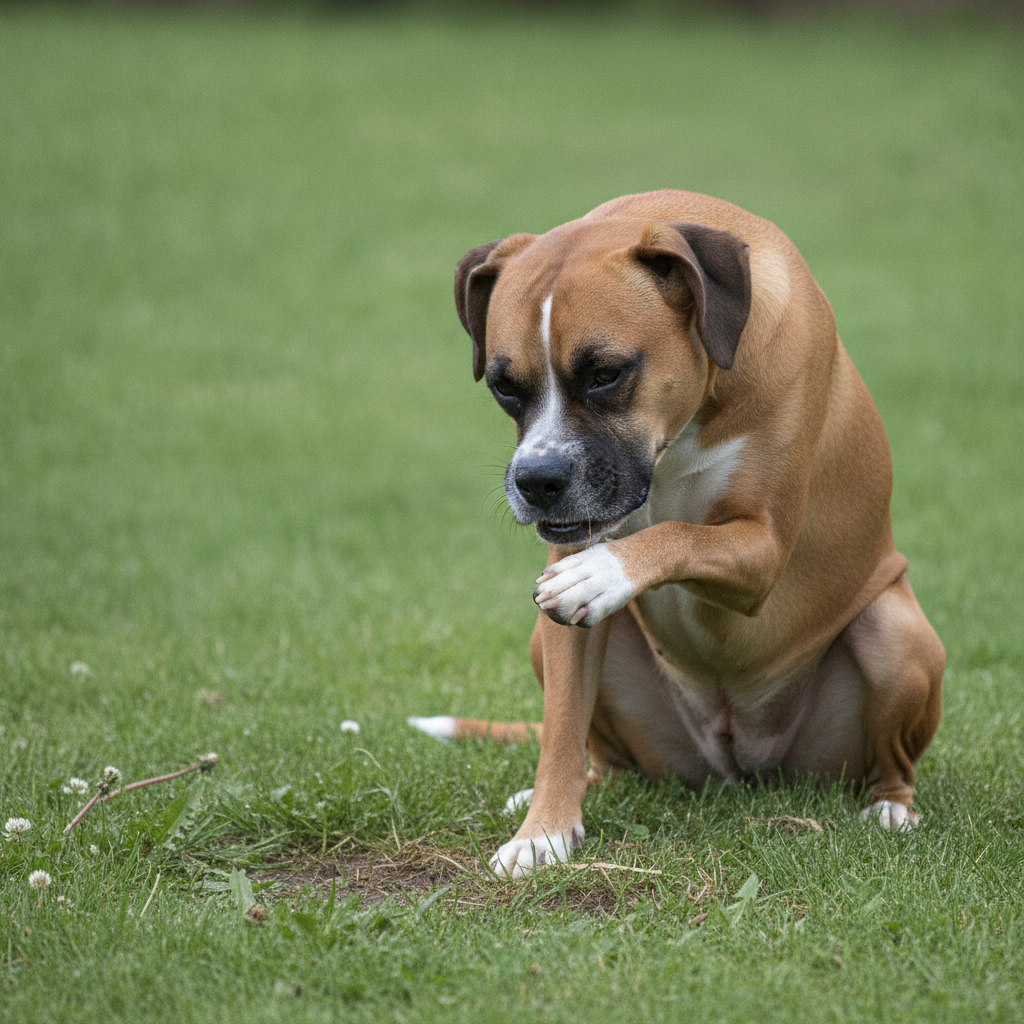
You’re watching TV and your dog starts working on a paw. Not licking, exactly. Nibbling, with the front teeth, at the nails specifically, with a small persistent clicking sound that eventually becomes impossible to ignore.
The instinct is to file it under quirk. He’s a nervous nail-biter, like a person.
That’s the wrong model, and it’s worth dismantling, because the human version of nail-biting, a diffuse anxious habit with no physical cause, is not really what dogs do. When a dog goes after their nails, there is almost always something at the nail. The behavior is a response, not a personality trait.
The good news is that telling a normal dog from a dog with a problem is unusually easy. You just need a stopwatch.
The fifteen-second rule
This is the most useful thing in this article and it takes no equipment.
Brief, occasional nibbling at a nail, lasting a few seconds, is normal grooming. Dogs clean their feet. They pull grit out from between their toes, work at a bit of mud, deal with a snag on a nail. It’s the equivalent of you picking something off your sleeve.
Anything past roughly ten to fifteen seconds, or anything repeated, is a symptom. Sustained chewing at the nails is not something a comfortable dog does. It means the paw is itchy, sore, or wrong in some way.
So: watch the clock, and count the episodes. A few seconds, once in a while, is a dog. A minute at a time, several times a day, is a dog telling you something.
Two other things worth logging while you’re watching:
- Which paw, or which nail? A dog who only ever works on one foot has a local problem: an injury, a foreign body, an infected nail bed. A dog who cycles through all four is more likely to have a systemic problem, which usually means allergies.
- When? Immediately after walks points hard at something environmental picked up outside. Only in the evening, or only when left alone, points more toward habit and stress. Year-round versus seasonally is one of the most useful allergy clues you can collect.
What’s actually going on
Overgrown nails, and the mechanic nobody explains
This is the most common cause and the most fixable, and the way it works is not obvious.
A dog’s nail contains a quick: the living core, with blood supply and nerve. And here’s the thing people don’t know: the quick grows out with the nail. Let the nails get long, and the quick lengthens right along with them, which is precisely why you can’t just cut a long-nailed dog’s nails short in one go. You’d cut through living tissue.
When nails get long enough to hit the ground before the paw pad does, several things happen at once. The nail is pushed backwards into the nail bed with every single step, which hurts. The toe joints are forced into an unnatural position. The dog’s whole posture shifts to compensate, transferring load onto the wrists and shoulders. And in bad cases the nail curls round and grows into the pad.
A dog with that going on will chew at their nails, because the nails are the thing that hurts.
The test: stand your dog on a hard floor. If you can hear a click when they walk, the nails are too long. If you can see daylight-free contact between nail and floor when they’re standing still, they’re much too long.
The fix, and the timeline: trim or grind a very small amount every week. Not a big trim every three months, which is what most people do and which is both terrifying for the dog and impossible to do properly. Small, frequent removal causes the quick to recede over time, and after a couple of months of weekly work you can get the nail genuinely short. It takes patience and it is completely worth it.
A rotary grinder is often less frightening than clippers for a dog who has had a bad experience, because there’s no sudden crunch and no pinch, and it’s much harder to hit the quick.
Allergies, the most common systemic cause
If your dog chews at all four feet, thinks about the ears, and the itching is worse at certain times of year, this is almost certainly allergy.
Some scale, so you know how ordinary this is: roughly 20 to 30 per cent of dogs show some form of allergic skin disease, and canine atopic dermatitis, the environmental-allergy version, affects up to around 10 per cent of all dogs. It is one of the most common reasons dogs go to the vet at all.
Feet are ground zero. They’re in constant contact with grass, pollen, mould, and dust. They’re also thin-skinned and easy to reach. So an allergic dog chews their feet, and the chewing damages the skin, and the damaged skin gets infected, and the infection itches, and the dog chews more.
The visible tells: rust-brown staining on white fur between the toes (that’s saliva, and it’s a reliable sign of chronic licking), red skin between the pads, a yeasty smell, and swelling of the nail beds.
Allergy is treatable, and modern treatment is genuinely good. Targeted medications now available, an injectable antibody and a daily tablet in the JAK-inhibitor class, control itch far more precisely than the old steroid approach, and a recent retrospective study of the injectable reported treatment success in around 88 per cent of allergic dermatitis cases. That’s not a marketing number; that’s a real change in what’s achievable. Talk to your vet.
The nail bed itself
Worth checking directly, because it’s easy to miss under fur.
- A broken or split nail. Splits can run up into the toe, expose the quick, and get infected. Dogs chew at these obsessively and it’s genuinely painful.
- A nail-bed infection (paronychia). Swelling and redness around the base of one or two nails, sometimes with discharge, sometimes with a bad smell.
- A foreign body. A grass seed or splinter driven up between the toes. Common in summer, and often a single-paw problem.
- Nails that are misshapen, brittle, splitting, or falling out, across multiple feet. This is a different and more serious category, and it needs a vet, not a nail file.
Anxiety and habit, which is real but is not the first answer
Some dogs do chew as a self-soothing behavior, and repetitive licking or chewing can genuinely become self-reinforcing over time: it starts as a response to an itch, it produces a small hit of relief, and eventually the dog keeps doing it after the original cause is gone.
But this is a diagnosis of exclusion, and it comes last, not first. Assuming a behavioral cause when the actual problem is a yeast infection or a long nail is how dogs end up chewing for a year while their owner buys anxiety wraps.
“Owners tell me their dog is a nervous nail-biter and I always want to look at the feet before I look at the anxiety,” says Dr. Mara Chen. “Dogs don’t chew their nails for no reason the way people do. There is nearly always something down there, and by the time we get to genuine self-soothing, it usually started with something physical and became a habit later.”
If it does turn out to be behavioral, the answer is more mental work, more sniffing, more enrichment, and a legitimate alternative outlet, a chew, a stuffed toy, a puzzle feeder, rather than trying to suppress the behavior.
What to do, in order
- Look at the feet. Properly, in good light, with the fur parted. Nail beds, between the toes, the pads. Look for redness, swelling, brown staining, discharge, a split nail, a foreign body.
- Check the nail length. Stand them on a hard floor. Listen for clicks.
- Start weekly trimming or grinding, in tiny increments, paired with treats. If your dog is afraid of the process, build up over weeks: show the clippers, treat, touch a paw, treat, touch the clippers to a nail, treat. Do not force it.
- Wash the feet after walks if the chewing is worse after being outside. A rinse in plain water and a proper dry, especially between the toes, removes a lot of surface allergens. Damp feet grow yeast, so the drying matters as much as the washing.
- Go to the vet if the chewing is more than fleeting, if it’s happening daily, if there’s redness, swelling, smell, discharge, limping, or a damaged nail, or if it isn’t resolving after you’ve fixed the obvious.
Do not put a bitter spray on it and consider the matter closed. That’s a way to leave an itchy, sore dog itchy and sore, while making them taste bad.
What newer research adds
The big change here is in what a vet can offer for the allergy cases, which are the majority of the persistent ones.
Until fairly recently, an itchy dog got steroids, with all the side effects that implies, or long courses of cyclosporine. The current options are targeted at the specific signalling molecules that drive itch, and they work faster and cleaner. A monoclonal antibody given by injection every four to eight weeks, and an oral drug in the JAK-inhibitor class, now form the backbone of treatment, and long-term studies published in 2025 report most dogs maintaining meaningful reductions in itch scores over extended periods.
The practical implication for a dog with chewed-up feet is that “he’s just an itchy dog, nothing to be done” is out of date. It stopped being true.
The other useful development is the wider recognition that nail length is a welfare issue rather than a cosmetic one. Long nails change how a dog stands and moves, load the wrist and shoulder abnormally, and contribute to discomfort in older dogs who are already dealing with arthritis. The click on the kitchen floor isn’t a grooming failure. It’s a small, continuous mechanical problem you can fix with ten seconds a week.
FAQ
So a bit of nibbling is fine? A few seconds here and there is ordinary grooming. What isn’t ordinary is chewing that keeps going, past that ten-to-fifteen-second mark, or that comes back to the same paw night after night. That version has a physical driver behind it.
What actually makes the chewing stop? Nothing you do to the dog. You have to remove the reason. Start with nail length, then check the paw itself for redness, swelling, rusty staining, or a split. If the chewing outlasts those fixes, the answer is a vet, not a deterrent spray.
How short should my dog’s nails be? Short enough that they don’t touch the ground when your dog is standing on a hard floor. If you can hear clicking, they’re too long.
My dog only chews one paw. Does that change anything? Yes, and it’s useful. A single paw suggests a local problem: an injury, a split nail, a foreign body, or an infected nail bed. All four paws points more toward allergies.
Can allergies really cause nail chewing? Yes, and they’re one of the most common causes. Allergic dogs chew their feet, and it’s very treatable with modern medication. It’s worth a vet visit rather than a year of bitter spray.
References
- “Allergies in Dogs.” VCA Animal Hospitals. https://vcahospitals.com/know-your-pet/allergy-general-in-dogs
- “Canine Atopic Dermatitis: Prevalence, Impact, and Management Strategies.” Veterinary Medicine: Research and Reports, 2023. https://www.tandfonline.com/doi/full/10.2147/VMRR.S412570
- “Long term use of lokivetmab (Cytopoint) in atopic dogs.” PubMed Central, 2025. https://www.ncbi.nlm.nih.gov/pmc/articles/PMC11938560/
- Arhant, C., et al. “Chewing behaviour in dogs — A survey-based exploratory study.” Applied Animal Behaviour Science, 2021. https://doi.org/10.1016/j.applanim.2021.105372
- “Nail Trimming in Dogs.” American Kennel Club. https://www.akc.org/expert-advice/health/how-to-trim-your-dogs-nails/