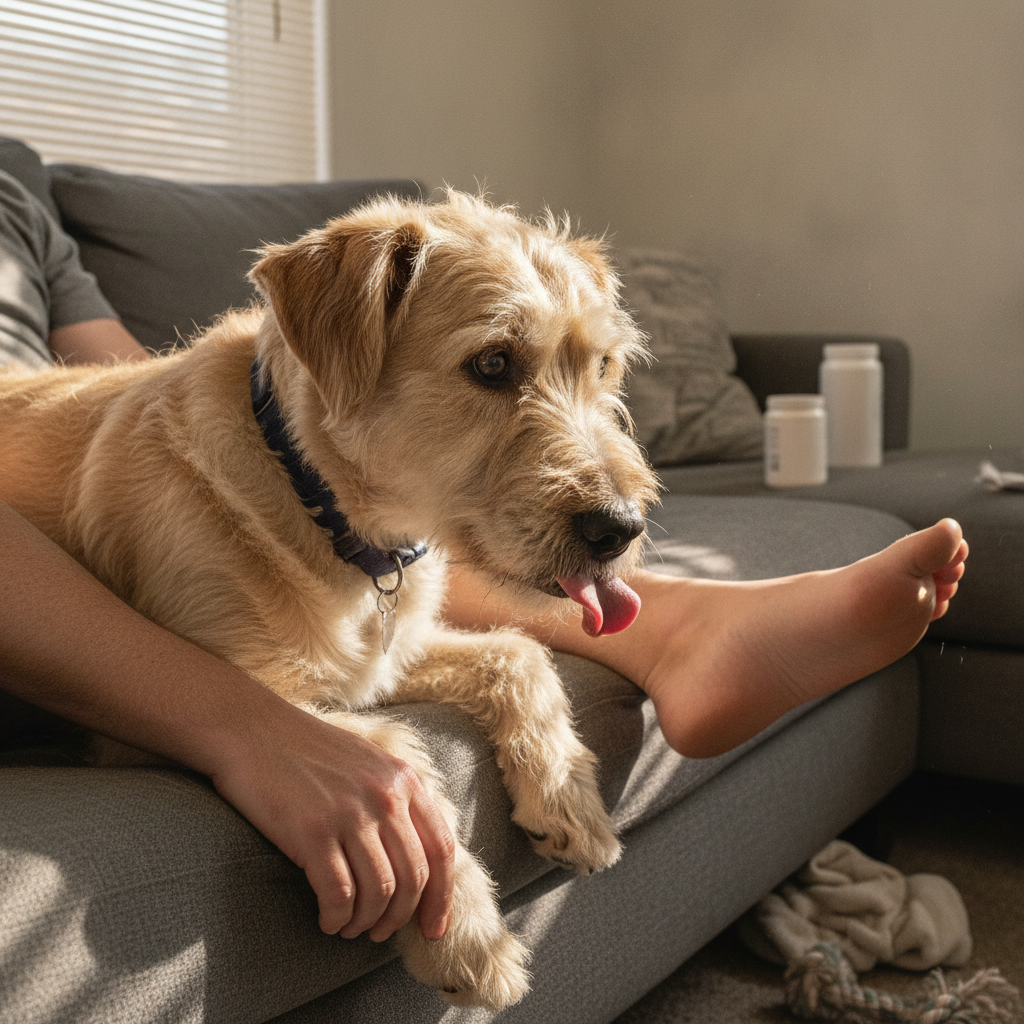
You come home from a run, peel off your shoes, and within ten seconds there is a dog on your feet, working with the focus of a forensic technician. It reads like love. It feels, honestly, a little gross.
Here is the reframe that makes the whole behavior make sense: your dog is not kissing your feet. They are reading them. Feet are the single most information-dense part of you, and licking is how a dog turns a smell into a taste and takes the sample apart.
Once you see it as data collection rather than affection, everything else about the habit, including how to stop it, gets much easier.
Why feet, specifically
A dog’s nose is not just better than yours, it is built on a different scale. Dogs carry roughly 300 million olfactory receptors compared to about six million in a human nose. And the anatomy sends about 12 percent of every breath to the olfactory region rather than to the lungs, so a sniffing dog is essentially running a dedicated intake for scent.
That machinery is wasted on a clean, sock-wrapped foot. It is not wasted on a bare one.
The sole of your foot has one of the highest densities of sweat glands anywhere on your body. Everything you walked through, everyone who walked there before you, and whatever your own body chemistry has been doing all day, it is all sitting right there in a warm, salty film at dog nose height. Licking pulls that sample onto the tongue, where taste and the vomeronasal system can work on it.
“Feet are the closest thing a dog has to your search history,” says Dr. Ravi Mehta. “They will tell your dog where you went, what you stepped in, who you stood next to, and whether your body chemistry shifted today. That is a lot of return on one lick.”
The four things a lick can mean
Foot-licking is not one message. Read the context and you can usually tell which one you are getting.
It’s a briefing. The most common version. Your dog is sampling the day off you. This one tends to happen right when you come home, right after shoes come off, and right after a shower or a swim.
It’s a greeting. Licking around the face and muzzle is a genuine social behavior between bonded dogs, and it carries over to humans. Your face is out of reach; your feet are not. If the licking comes with a loose body, a low wagging tail, and a soft face, that is the affiliative version.
It’s a request. This is the one people accidentally build. Your dog licks your foot, you laugh, you look down, you talk to them, you move. From your dog’s point of view that is a lever that works every single time. Dogs repeat what pays. If the licking starts the moment you get on a call or open your laptop, you are not being adored, you are being paged.
It’s a taste. Sometimes the answer really is that you are salty and interesting. Dogs explore by mouth, and a bare foot after a workout is, to them, a legitimately novel flavor.
When to stop finding it cute
Most foot-licking is harmless. Two situations are not.
You have something on your feet. Antifungal cream, steroid cream, medicated lotion, prescription patches, essential oils. If it is on your skin and your dog is licking your skin, your dog is taking the dose. Some of these are genuinely toxic to dogs in small amounts. If you treat your feet with anything medicated, licking is off the table, full stop.
Your skin is not intact. A crack, a blister, a callus you picked at, a healing cut. Dog mouths carry bacteria that are a non-event on unbroken skin and a real problem in a wound. The CDC flags Capnocytophaga, a bacterium common in healthy dog and cat mouths, as capable of causing serious infection when saliva reaches broken skin, especially in people who are immunocompromised, who have had their spleen removed, or who drink heavily. It’s rare. It is also not worth courting over a habit you did not want anyway.
There is a third, quieter flag. If the licking has become compulsive, if your dog fixates and cannot be interrupted, if it comes packaged with panting, pacing, or trailing you room to room, the licking may be a self-soothing behavior rather than a social one. That is worth a conversation with your vet, because the licking is the symptom and the anxiety is the thing to treat.
How to end it without shutting your dog down
The lazy fix is socks. It genuinely works, and there is no shame in it.
If you want the behavior actually trained out, the mechanics are simple, but the order matters.
- Stop paying it. The single biggest driver of a persistent foot-licking habit is the reaction it earns. When it starts, do not laugh, do not scold, do not narrate. Move your feet away and give your dog nothing. No eye contact, no talking. The behavior has to stop working.
- Give the mouth a job. Interrupt with something better and legal: a stuffed food toy, a chew, a puzzle feeder. You are not rewarding the lick, you are replacing the activity. Hand it over once your dog has already disengaged, not mid-lick.
- Reward the alternative. The instant your dog turns to the toy or settles somewhere else, mark it and pay it. Praise, a treat, a scratch. You are teaching the sentence feet get nothing, that mat gets everything.
- Install a cue. “Leave it” and “out” are worth having for a hundred reasons and this is one of them. Build them separately, in calm conditions, then bring them to the couch.
- Check the boredom budget. A dog with nothing to do will invent something to do, and you are the most interesting object in the room. Walks, sniff time, training games, real physical exercise. A tired dog is not licking your feet.
- Be consistent across humans. If one person in the house thinks it’s adorable, the habit survives. Dogs learn from the household, not from you.
And, gently, one more: consider the possibility that your feet are unusually interesting. If your dog goes after them with unusual intensity, more frequent washing, breathable shoes, and moisture-wicking socks will lower the reward on offer.
What’s new since this was written
The evidence keeps pointing the same direction: dog licking of humans is mostly normal social and investigative behavior, and the health caveats are narrow but real. The CDC’s current guidance on Capnocytophaga is still that these bacteria live in the mouths of most healthy dogs and cats, that most people who have contact with dogs never get sick, and that the risk concentrates in people with weakened immune systems or broken skin. Wash any spot your dog has licked if the skin is not intact, and call a doctor if a fever, chills, or redness follows within a few days.
The other thing worth knowing is that persistent licking is increasingly treated by behavior vets as a stress signal rather than a quirk. If the habit is escalating rather than fading, that is a reason to ask why, not just how to stop it.
References
- Jenkins, Eileen K., et al. “When the Nose Doesn’t Know: Canine Olfactory Function Associated with Health, Management, and Potential Links to Microbiota.” Frontiers in Veterinary Science, vol. 5, 2018. https://www.frontiersin.org/articles/10.3389/fvets.2018.00056/full
- Craven, Brent A., Eric G. Paterson, and Gary S. Settles. “The Fluid Dynamics of Canine Olfaction: Unique Nasal Airflow Patterns as an Explanation of Macrosmia.” Journal of the Royal Society Interface, vol. 7, no. 47, 2010, pp. 933–943. https://royalsocietypublishing.org/doi/10.1098/rsif.2009.0490
- Centers for Disease Control and Prevention. “About Capnocytophaga.” https://www.cdc.gov/capnocytophaga/about/index.html
- American Veterinary Medical Association. “Pets and People: Healthy Interactions.” https://www.avma.org/resources/pet-owners/petcare/pets-and-people-healthy-interactions