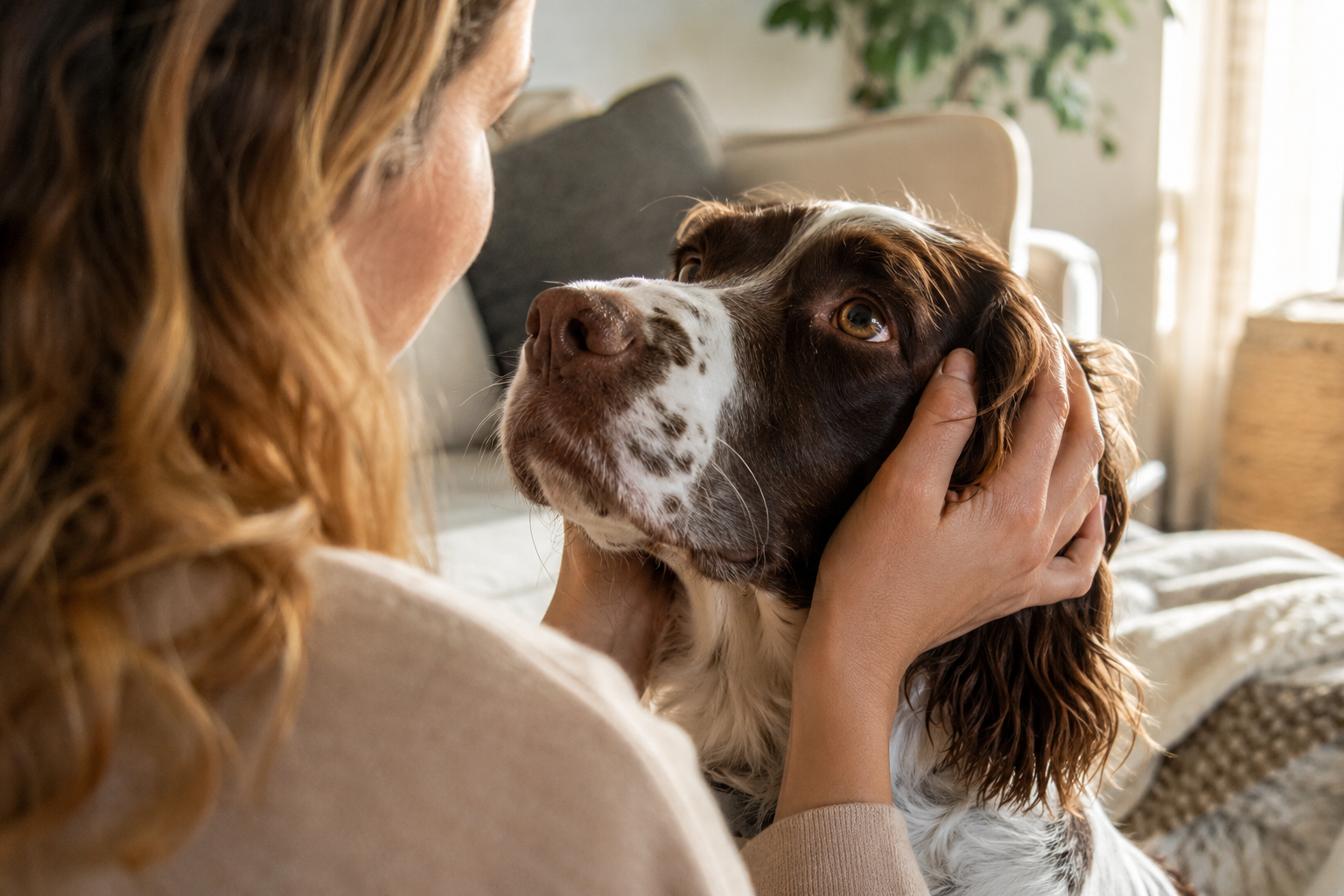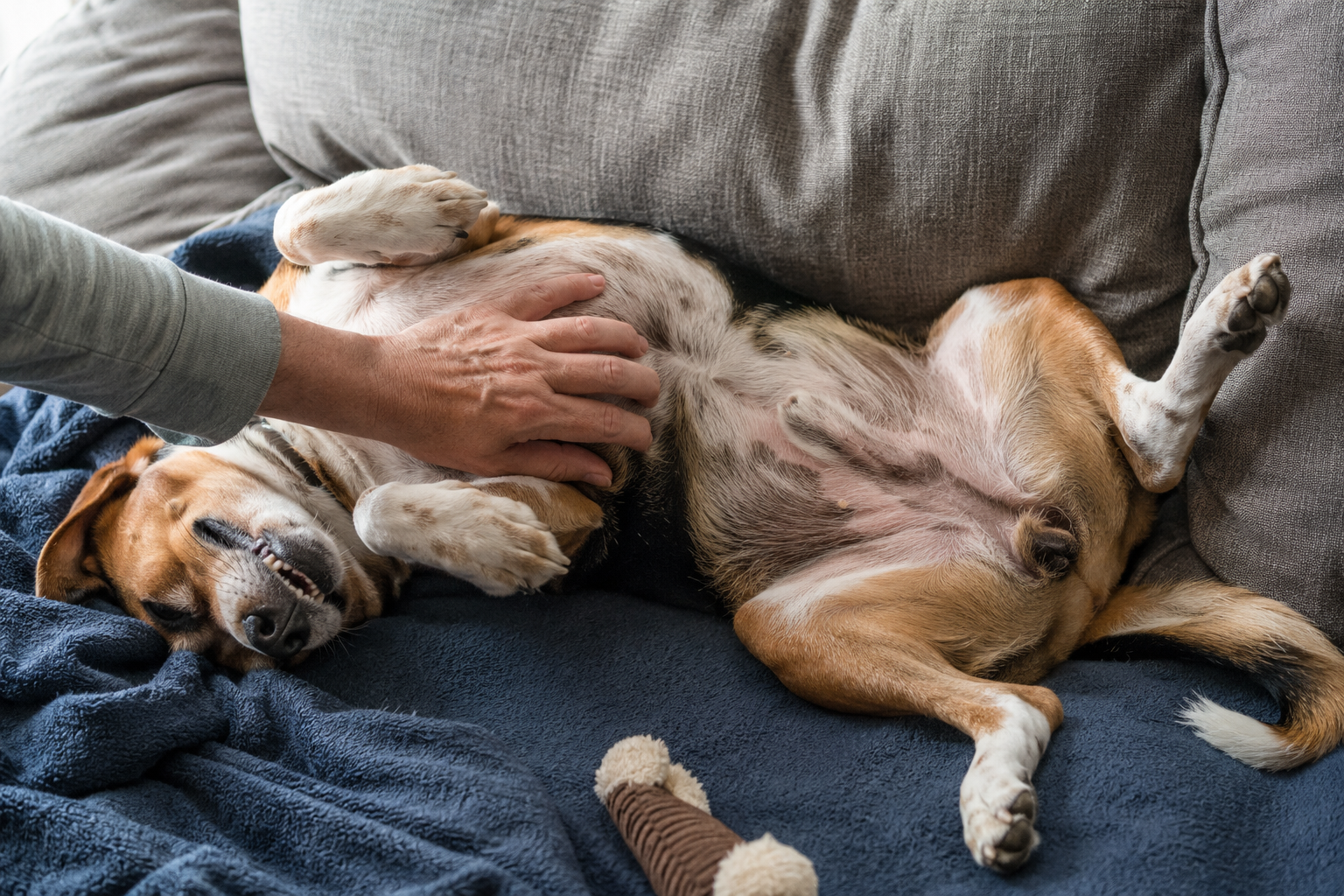
Nobody trains a dog perfectly. That is not the interesting part.
The interesting part is what a dog does when the signals do not add up. They do not freeze, and they do not ask for clarification. They fall back on the least risky option available, which is very often the exact opposite of what you wanted. The dog who “ignores” the recall in the park is frequently a dog who has learned that coming back is a coin flip, sometimes a treat, sometimes the end of all fun, sometimes a scolding for taking too long. Faced with a coin flip, they keep sniffing.
So the failure people describe as stubbornness is usually an inconsistency problem, and it is almost never located in the dog. It is distributed across a household: two adults, a teenager, a visiting parent, and a set of rules that shift depending on who is in the room and what day it is.
The dogs pay for that in a specific way. Confusion becomes frustration, and frustration comes out as barking, whining, paw-chewing, and a general low-grade worry. It looks like a behavior problem. It is a communication problem.
Here are the six places the contradictions live, ordered from the ones inside your own mouth to the ones inside your household.
1. Your cues are not actually cues
Start with the words, because they are the cheapest thing to fix.
“Sit down” contains two cues. If your dog knows “sit” and knows “down,” you have just asked for both at once and left them to pick. “Down” is worse: most households use it for lie down, and shout it when the dog jumps on a guest, and use it to mean get off the sofa. Three meanings, one sound. No animal can sort that.
Give each behavior its own dedicated word and keep it: “down” for lie down, “off” for get off that thing. Boring, unambiguous, and it works.
The same applies to volume of language. Dogs are not parsing your sentences. When you say “will you please stop that and come here,” a dog who knows “stop” and “come” has received both cues, wrapped in noise, in a tone that suggests something has gone wrong. Cut the chatter around the cue. One word, once, in a normal voice.
2. Your timing turns a reward into a mystery
Even a perfect cue fails if the payoff arrives late.
A dog connects a reward to what they were doing at the moment it arrived, not to what you were thinking about. Reward two seconds after the sit, and the dog was already standing, sniffing, or turning away. You just paid for that instead.
The fix is a marker: a short, consistent sound that means “that, right there, is what earned this.” A clicker, or a bright, unvarying “yes.” Mark the instant the behavior happens, then deliver the food. The marker buys you the second or two it takes to get the treat out of your pocket, and it makes your timing surgical instead of approximate.
“Almost every dog I meet who is described as slow to learn is being reinforced perfectly well, just for the wrong half-second,” says Dr. Priya Nair, DVM. “Fix the marker before you fix anything else. It is the cheapest change in all of dog training and it makes the rest of it legible.”
3. The couch is allowed on Tuesday
Now the household rules, which is where the real damage happens.
The sofa is either a dog place or it is not. What a dog cannot do is understand conditional access: allowed on the big sofa but not the good one, allowed on weekdays but not when your in-laws visit, allowed until they are muddy. Those distinctions are legible to you because you know why they exist. To your dog, the rule just changes without warning, and the surface that welcomed them yesterday gets them shouted at today.
That is not a discipline problem. That is a dog who cannot predict their own environment, and unpredictability is one of the most reliable sources of stress an animal can have.
Pick a rule you can hold on your worst day, with a hangover, with guests, in the rain. Then hold it. If you want the dog off the furniture when company comes, teach a “place” cue and a mat, so there is somewhere to go, not just somewhere to be evicted from.
4. Everyone in the house is training a different dog
The most common version: one person greets the dog by encouraging them up onto their chest, and the next person knees them off and says no. Same behavior, opposite consequences, both delivered warmly. Or the dog is made to wait politely for their bowl by you, and handed it mid-air by your partner.
Grandparents are famous for this, and they are not going to change. What can change is what everyone has agreed the rules are.
The intervention that actually works is embarrassingly analog: write them down. Cues in one column, house rules in the other, stuck to the fridge. What word means lie down. What word means get off. Whether the dog is allowed to greet by jumping. Whether the dog waits for a release before eating. Everyone who lives with the dog, and everyone who dog-sits the dog, follows the list. It sounds like overkill for a family pet and it is the single highest-leverage thing in this article.
5. You start the game, then punish the game
You come home. The dog rockets up to greet you, and for the first minute or two it is wonderful, and you lean into it. Five minutes later you are still being jumped on while trying to put groceries away, and now it is annoying, and now the dog is in trouble.
From the dog’s side, nothing changed except your mood. That is exactly the kind of arbitrariness that leaves a dog anxious rather than trained.
Same story with play: you spend twenty minutes winding your dog up, encouraging them to leap and grab the toy out of your hands, and then the game ends and the next leap gets a sharp “no.”
Two fixes. Give the wild behavior a place, so rough play happens in the living room or the yard and not in the kitchen at 7pm. And teach an explicit end: a single word, “all done,” that reliably predicts the fun is over and calm is what happens next. An ending your dog can hear is infinitely kinder than an ending they have to guess.
6. Your panic is louder than your cue
Your dog is heading for a road, or has just swallowed something they should not have. This is precisely the moment your training is meant to pay off, and it is the moment most people blow it, because the fear comes out as volume.
A dog who hears a raised, frightened, angry voice does not read urgency. They read: something has gone wrong and the source of it is you. And a dog who thinks they are in trouble will not run toward you. They will hesitate, they will slow down, they will loop, and in the worst case they will avoid you entirely, which is the exact opposite of what you needed.
The cue you need in an emergency has to sound like every other time you have used it. Calm, clear, once. Then, when they come, pay them like they just saved their own life, even if you are furious, even if it took ten seconds. Punishing a slow recall is how you get no recall at all.
The one-sentence version
You do not need to be a better trainer. You need to be a more predictable one, and so does everyone else who lives with your dog.
Pick each word once. Mark the behavior the instant it happens. Write the house rules on the fridge and hold them when it is inconvenient. Give the fun an ending your dog can hear. And when it genuinely matters, use the voice you practiced with, not the one your adrenaline hands you.
A dog who can predict what you mean does not need much convincing to do it.
References
- Hiby, E. F., N. J. Rooney, and J. W. S. Bradshaw. “Dog training methods: their use, effectiveness and interaction with behaviour and welfare.” Animal Welfare, vol. 13, no. 1, 2004, pp. 63-69. cambridge.org
- Ziv, Gal. “The effects of using aversive training methods in dogs: A review.” Journal of Veterinary Behavior, vol. 19, 2017, pp. 50-60. sciencedirect.com
- China, Lucy, Daniel S. Mills, and Jonathan J. Cooper. “Efficacy of Dog Training With and Without Remote Electronic Collars vs. a Focus on Positive Reinforcement.” Frontiers in Veterinary Science, vol. 7, 2020. frontiersin.org