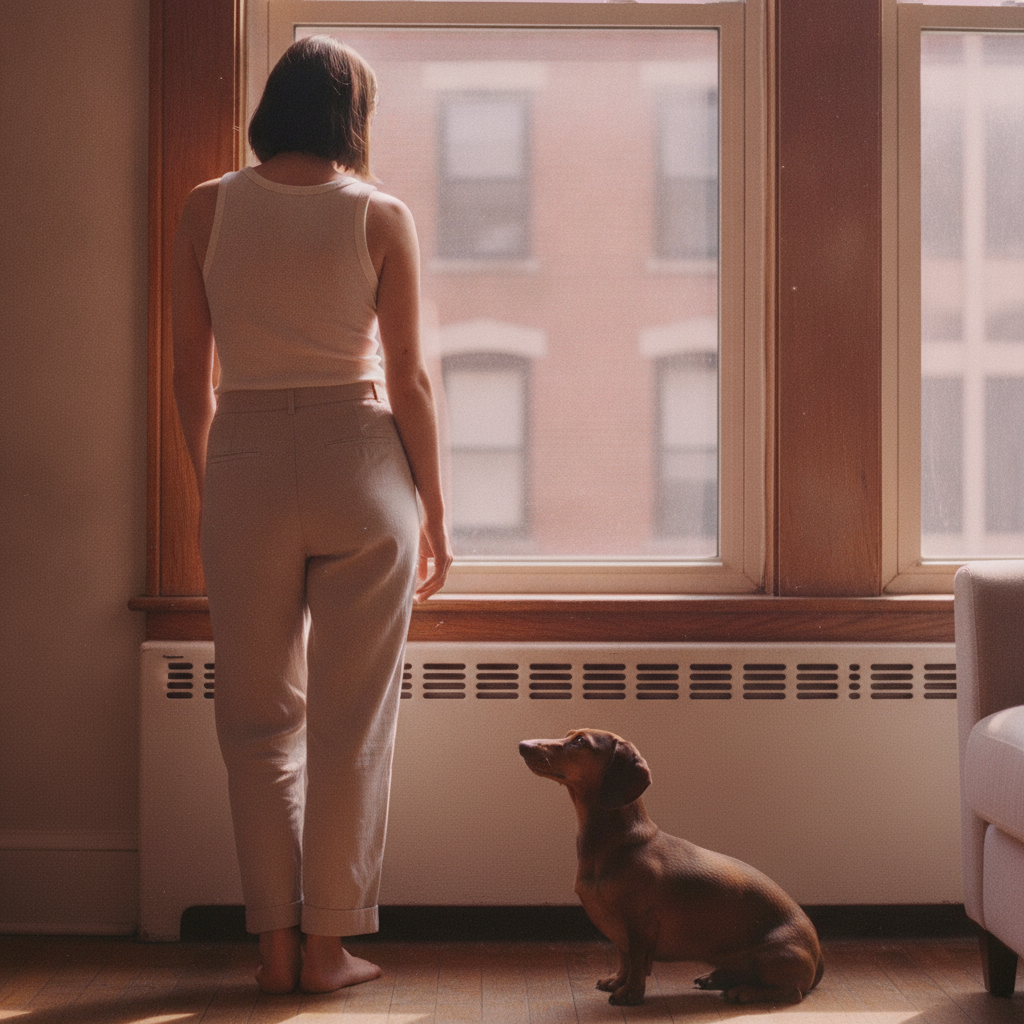
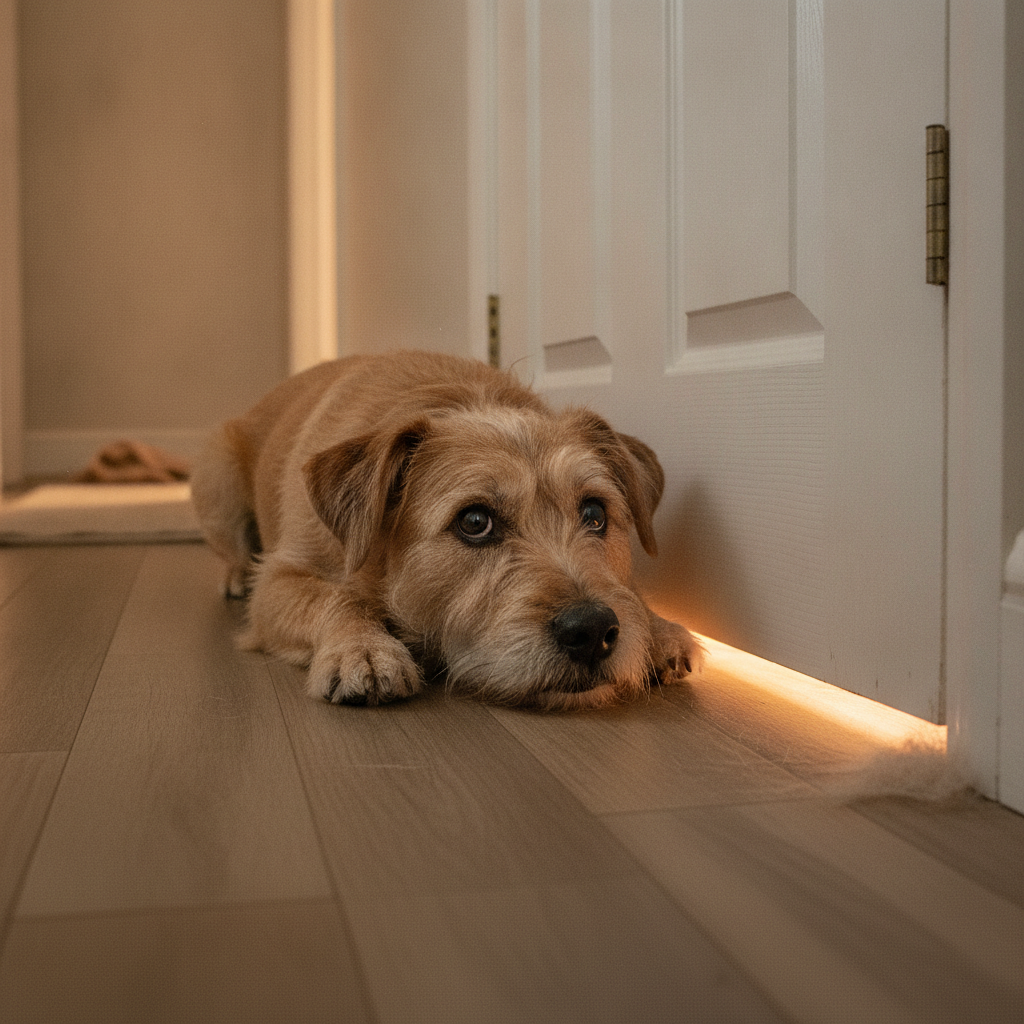
You get up. They get up. You walk down the hall. They walk down the hall. You close a door and a nose appears under it, and then a paw, and then the whole dog, and you are now having a private moment with an audience.
The internet has decided this is simply devotion, and mostly it is. But buried in the list of ordinary explanations there is one that is worth taking seriously, because it is the same thing that makes a dog destroy a door frame when you go to work, just in miniature.
So: five reasons, and how to work out which one you have.
(The version of this article that has circulated for years lists seven. Two of them were the same reason wearing different hats. Here are the five that actually do work.)
1. You are the pack, and the pack goes together
Dogs are intensely social and they orient around their people. They do not follow you to the bathroom for bathroom reasons. They follow you because you are moving and they would rather be where you are.
To your dog, the bathroom is not a private space. It is a room. There is no category in a dog’s head labeled “places I should let him be alone.” If they follow you to the kitchen, the bedroom, and the hallway, of course they follow you to the bathroom.
For many dogs, proximity is also just comfortable. They feel more secure near you, and following you around tops up that feeling all day. Over years, it deepens rather than fades.
2. Curiosity, and a room that is genuinely interesting
We think of the bathroom as boring because we cannot smell.
Your dog can. A bathroom is a dense, layered, constantly refreshed archive of scent: soaps, shampoos, lotions, perfumes, and a great deal of unambiguous information about the humans who live there. It also has running water, which is fascinating, and a toilet that makes a noise and then refills, which is arguably the best show in the house.
Puppies in particular find bathrooms riveting. They will happily sit and supervise the entire operation.
This is the most benign explanation on the list, and it is also, for a lot of dogs, the correct one.
3. It works, and it has always worked
Somewhere early on, your dog followed you in, and you found it charming. You laughed. You reached down and scratched their ears. Possibly, at some point, they got a treat out of it.
Dogs are quick, and this is a very short inference. Following you to the bathroom produces attention.
Once that is established, it does not need any deeper motive. The behavior maintains itself, because you keep paying for it.
4. Habit, which is not nothing
Dogs are creatures of routine to a degree that people consistently underestimate. If your dog has followed you into the bathroom every day for six years, they are now doing it in the way you check your phone when you sit down. There is no live motive. It is a groove.
This one is easy to spot: a habit-driven dog follows you in, lies down, and looks bored. They are not watching you with intent. They are simply where they always are.
5. Anxiety, and the fear of being left
Here is the one that matters.
When you walk out of a room, your dog sees you leaving. To you, the bathroom is eight feet away and you will be back in three minutes. Your dog does not have that information. For a dog with separation-related anxiety, a closed door between you is not a short separation. It is the separation, the one that happens before you disappear for the whole day.
Following you in is how they prevent it.
The distinction to make is between a dog that prefers to be near you and a dog that cannot tolerate not being. They look similar in the hallway and they are completely different animals.
Signs it is anxiety and not affection:
- The dog becomes distressed when the door closes: whining, scratching, pacing, barking, drooling.
- They are agitated on arrival rather than settled, unable to lie down, watching the door rather than you.
- The following is frantic rather than casual, and it happens the instant you shift your weight.
- The same dog shows other separation-related problems: destruction, vocalizing, or house-soiling when you actually leave.
- They shadow you everywhere, all day, with an intensity that does not look relaxed.
A dog that ambles in, flops on the bath mat, and sighs, is a dog keeping you company. A dog that stands rigid in the doorway, panting, is a dog managing fear.
“The bathroom is a good diagnostic, actually, because it is the shortest separation in a dog’s day,” says Dr. Nina Kohl. “If a dog cannot cope with you being behind a door for two minutes, that tells me something about how they cope with you being gone for eight hours. I would much rather someone brought me that observation than waited until the sofa was destroyed.”
If that is your dog, this is not a habit to manage. It is a welfare problem to treat, and it responds well to a proper behavior-modification plan, sometimes supported by medication. Talk to your vet or a qualified behavior professional.
Do you actually need to change it?
For four of the five reasons: no. If you find it endearing, and your dog is relaxed about it, there is nothing to fix. This is a preference, not a problem.
If you would like your privacy back, and the dog is not anxious, here is what works.
Ignore the following. No greeting, no eye contact, no scratch, no treat. If the behavior is attention-driven, and it often is, removing the payment removes the behavior.
Reward staying. This is the half people forget. Actively reinforce your dog for not following: praise or a treat when they stay on their bed as you leave the room. You are not just deleting a behavior, you are teaching a better one, and dogs learn far faster with something to do than with something to avoid.
Give them somewhere good to be. A comfortable, secure spot they actually like: a crate they enjoy, a bed, a corner with their favorite things in it. A dog with a great place to be is less compelled to be wherever you are.
Train the stay, properly and gradually. Teach your dog to remain outside the bathroom door. Start with the door open and one step away. Build distance and duration slowly. Use a baby gate if you need a physical marker while the training takes. Reward heavily every step of the way.
And escalate if it is anxiety. If any of the above produces distress rather than progress, stop. You have the fifth reason, not the third, and pushing through it will make it worse. That is a conversation with a vet or a professional trainer, and it may include a behavior-modification protocol or medication for a dog whose anxiety is severe.
What newer research adds
The interesting shift in this area is the growing recognition of just how variable normal is.
Some of it is genuinely genetic. Breeds developed to work in close partnership with a handler, the herding and gundog groups especially, tend to keep a person in view as a matter of design. A Border Collie following you to the bathroom is doing a slightly different thing than a Basenji doing the same.
And the guarding breeds bring their own version: dogs bred to protect will position themselves at a threshold, in a small enclosed space, with their person, because that is a sensible tactical decision if your job is to notice things first. It is not paranoia. It is a job description.
The more useful development, though, is the increasing precision about separation-related distress, and the recognition that it exists on a spectrum with a very ordinary-looking bottom end. The dog who cannot let you shut a door is not a different species from the dog who howls for six hours. They are the same problem at different volumes, and catching it at the bathroom door is far easier than catching it after the drywall is gone.
So enjoy the company. Just check, once, whether it is company.
References
- American Kennel Club. “Why Does My Dog Follow Me Everywhere?” https://www.akc.org/expert-advice/advice/why-does-my-dog-follow-me-everywhere/
- The Kennel Club. “Why does my dog follow me everywhere?” https://www.thekennelclub.org.uk/health-and-dog-care/health/health-and-care/a-z-of-health-and-care-issues/why-does-my-dog-follow-me-everywhere/
- Cornell Richard P. Riney Canine Health Center. “Separation anxiety.” https://www.vet.cornell.edu/departments-centers-and-institutes/riney-canine-health-center/canine-health-information
- Sargisson, R. J. “Canine separation anxiety: strategies for treatment and management.” Veterinary Medicine: Research and Reports, vol. 5, 2014. https://pmc.ncbi.nlm.nih.gov/articles/PMC6067676/
- American Veterinary Society of Animal Behavior. “Position Statement on Humane Dog Training.” https://avsab.org/resources/position-statements/