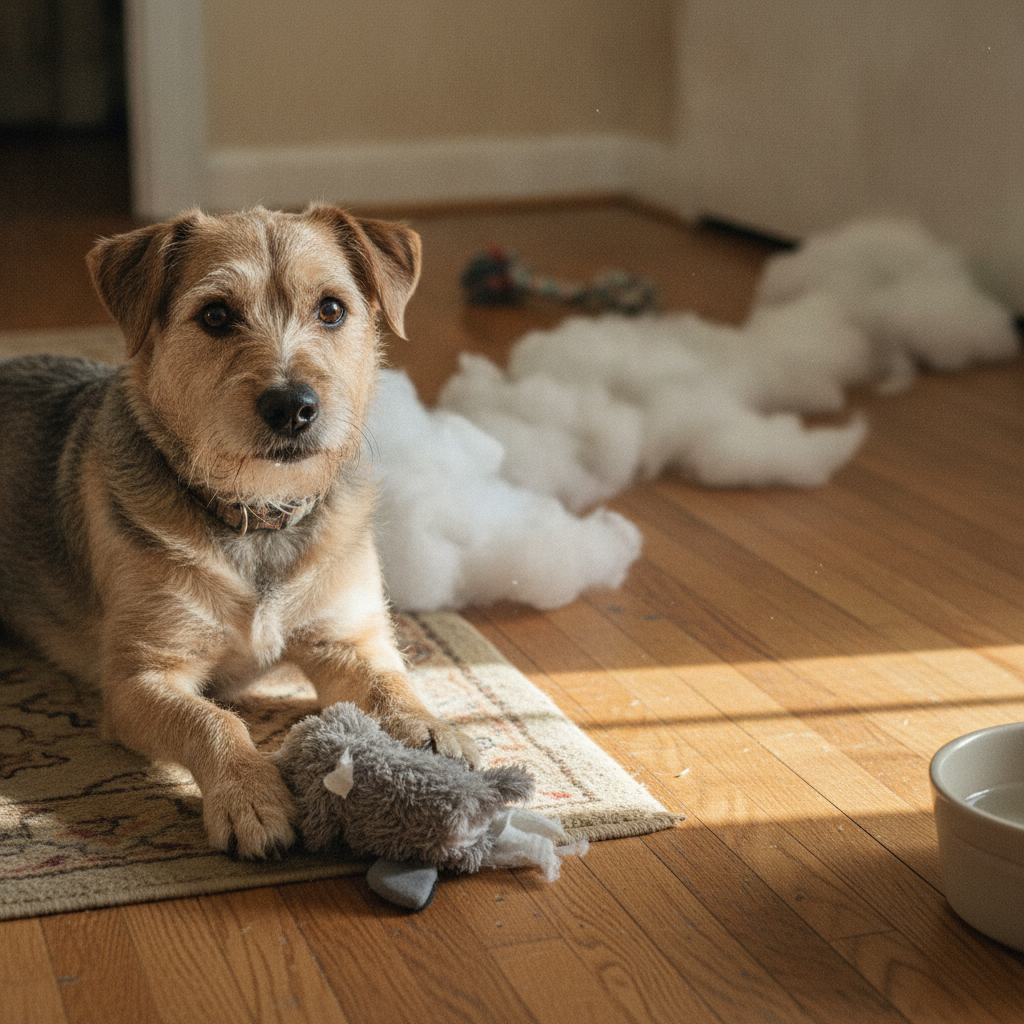
You stood in the aisle for twenty minutes. You picked the good one. Twenty minutes later there is stuffing on the rug and a squeaker under the couch, and the ninety-nine-cent rope toy you grabbed as an afterthought is still intact, being carried around like an heirloom.
It feels personal. It isn’t. Your dog is not ranking your gifts. They are running a sequence they were born with, and the toy that gets destroyed is simply the one that fits a different step of it than the toy that gets babied.
Once you see the sequence, the toy bin stops being a mystery and starts being a set of tools.
The four-step program running in your dog’s head
Predatory behavior in dogs is not one impulse. It’s a chain: stalk, chase, grab, kill, consume. Selective breeding chopped that chain up and handed different breeds different pieces of it. Herding dogs got a lot of stalk and chase and almost no grab. Terriers got the grab-and-shake in surround sound. Retrievers got a soft mouth that carries and refuses to crush.
A toy is a stand-in for a small animal. Which part of the toy your dog attacks tells you which link of the chain they are strongest in.
- The shredder is finishing the sequence. Grab, shake, tear open, remove the innards. The stuffing on your rug is, anatomically speaking, exactly what it looks like.
- The carrier is stuck at the retrieve. They found the thing. They are bringing you the thing. Crushing it would be a failure.
- The shaker is all neck. They will kill a plush hedgehog fifty times a day and never open it.
- The chewer skipped the hunt entirely and went straight to consume. Jaw pressure, no drama.
Most dogs run two of these. Almost none run all four. The toy you bought landed on one of them, and that’s the whole story.
“People come in convinced their dog has a preference problem, and what they actually have is a category problem,” says Dr. Nina Kohl. “A dog who guts every plush toy in the house isn’t being ungrateful. They’re doing the last step of a job nobody gave them a real outlet for.”
Why some toys get “babied” and never touched
The mystery toy is the one that survives. There is usually a reason, and it is almost never sentiment.
It doesn’t ask to be killed. No squeaker, no crinkle, no grunt. Nothing inside it is pretending to be alive, so nothing needs to be silenced. Silence is the single most reliable predictor of a toy that lives a long life.
It smells like a person, not a store. Dogs frequently treat gifted or secondhand items differently from new ones. A toy carrying the scent of your home, your bed, or another household dog reads as ours, not prey. That is why a hand-me-down from a friend’s dog can survive a shredder that has never let a new plushie see a second day.
It’s the wrong texture to open. A dense rubber ball has no seam to exploit. A thin-fleece plush has a seam that basically volunteers. Dogs are efficient. If a toy can’t be opened, they stop trying to open it and start doing something else with it.
It’s tied to a game you play together. A tug rope gets destroyed because tug involves your hands pulling in the opposite direction, which is the exact mechanical condition that rips fabric. A fetch ball survives because fetch is a carry, not a kill. The toy isn’t being treated better; it’s being used differently.
The part that actually matters: shredding is normal, swallowing is not
Here is the line, and it’s a sharp one.
Destruction, by itself, is not dangerous. A dog who de-stuffs a toy, walks away, and leaves the mess for you has done nothing wrong except make a mess. That is normal, healthy, deeply canine behavior and there is no reason to stop it.
Ingestion is a different animal entirely. The risk isn’t the tearing. It’s what goes down the throat afterward.
- A little stuffing usually passes. Watch for vomiting, appetite loss, or straining, and call your vet if any of it shows up.
- A swallowed squeaker is a foreign-body risk and worth a same-day call. Plastic squeakers do not break down, and they are exactly the wrong size and shape to move through a small intestine politely.
- Anything lodged in the throat is an emergency. Learn the canine Heimlich before you need it, not during.
- Rope fibers and long strings are the quiet killer. Linear foreign bodies can saw through intestine. If your dog eats rope, rope toys are over for them, permanently.
So the working rule is not “stop the destruction.” It’s supervise the destruction and end it before consumption starts. If your dog rips a toy open and then goes hunting for the squeaker, playtime with that toy is finished and the toy goes in the trash. As soon as a toy has a hole in it, it also has a way for a tooth, a tongue, or a paw to get stuck.
Match the toy to the job, not to the aisle
This is where most people go wrong. They buy toys by cuteness and then feel betrayed. Buy by function instead.
| If your dog… | Give them | Skip |
|---|---|---|
| Guts plush toys in minutes | Supervised “kill” toys with no hard squeaker, plus a real shred outlet (a cardboard box stuffed with treats) | Anything with a plastic squeaker they can free |
| Carries things gently everywhere | Plush, soft rubber, fetch objects | Nothing — this dog is easy |
| Shakes but never opens | Long-bodied plush without stuffing (the “skin” toys) | Small toys they could inhale mid-shake |
| Grinds and chews with steady pressure | Dense solid rubber, sized so it cannot fit fully behind the molars | Rope, tennis balls (the fuzz is an abrasive), anything hollow enough to trap a jaw |
| Destroys out of boredom, not glee | Food-dispensing and puzzle toys, which shift focus from destroying to solving | More plush |
That last row matters more than the others. If the destruction happens mostly when you’re gone, or ramps up as your dog gets less exercise, the toy isn’t the problem. Chewing and shredding are self-soothing behaviors, and a dog who is under-stimulated or genuinely anxious will use them the way a stressed person uses their fingernails. Adding one more plushie to the pile fixes nothing. Adding a sniffing walk, a training session, or a food puzzle usually does.
The cheapest fix nobody uses: put the toys away
A dog with eleven toys available at all times has no toys. Novelty is doing most of the work here, and once a toy has been fully investigated, its value collapses. Keep four or five out. Rotate the rest in every week or two. A toy that has been out of circulation for ten days comes back interesting, which means it gets played with instead of gutted out of frustration.
And keep the survivor toys in the rotation. If your dog has a plush they’ve never harmed, that toy is doing something for them. Don’t retire it because it looks boring to you.
What newer research adds
A 2025 study in Frontiers in Behavioral Neuroscience put scented and unscented rubber chew toys in front of 29 puppies aged three to ten months to see whether smell would change how much they chewed. The interesting result wasn’t about scent at all. Across the board, the puppies mostly worked the edges of the toy rather than the middle, which the researchers attributed to the toy’s shape. Design, in other words, was pulling harder than smell.
That’s a useful thing for a shopper to know. Marketing loves to sell you a scent or a flavor. What your dog is actually responding to is geometry: where there’s an edge, a seam, or a lip they can get a tooth behind. If you want a toy to survive, look for one with nothing to grip. If you want a toy to be destroyed on purpose, as a sanctioned outlet, look for one that gives them somewhere to start.
Older kennel research points the same way. When given a range of toys, dogs consistently gravitate toward objects they can chew and objects that make noise, and they lose interest fast once a toy stops offering new information. Which is to say: your dog was never going to cherish the plush. The plush was always the point.
Bottom line
The destroyed toy is not a rejection. It’s a completed hunt, and the fact that your dog can complete one safely, in your living room, on a toy that costs less than dinner, is a small miracle of domestication.
Let them have it. Just be there when it happens, and throw the carcass away before they eat it.
FAQs
Is it bad to let my dog destroy their toys? No, as long as they aren’t swallowing the pieces. Tearing, shaking, and de-stuffing are normal outlets for chewing and predatory instincts. The danger is ingestion, not destruction.
Should I stop my dog from ripping the stuffing out? Not necessarily. Supervise instead. Let them open it, then take the toy away once it’s opened rather than letting them pick through the remains for the squeaker.
Why does my dog destroy new toys but not old ones? Old toys have lost their novelty and often their noise, and they smell like home rather than like a store. New toys are unexplored, usually squeak, and have intact seams to exploit.
Does destroying toys mean my dog is aggressive? No. Predatory play and aggression are separate behavioral systems. A dog who shreds a plush hedgehog is not more likely to be aggressive toward people or other dogs.
When should I throw a toy away? As soon as it has a hole, a loose piece, an exposed squeaker, or a frayed end. A damaged toy is a choking and obstruction hazard, and it can trap a tooth or a paw.
References
- Bradshaw, John W. S., et al. “Why Do Adult Dogs ‘Play’?” Behavioural Processes, vol. 110, Jan. 2015, pp. 82–87. https://doi.org/10.1016/j.beproc.2014.09.023
- Pullen, Anne J., et al. “Preferences for Toy Types and Presentations in Kennel Housed Dogs.” Applied Animal Behaviour Science, vol. 125, no. 3–4, July 2010, pp. 151–156. https://doi.org/10.1016/j.applanim.2010.04.004
- Mehrkam, Lindsay R., et al. “The Influence of Breed and Environmental Factors on Social and Solitary Play in Dogs (Canis lupus familiaris).” Learning & Behavior, vol. 45, no. 4, Dec. 2017, pp. 367–377. https://doi.org/10.3758/s13420-017-0283-0
- “To Chew or Not to Chew? Exploring the Influence of Scented Chew Toys on Puppy Chewing.” Frontiers in Behavioral Neuroscience, 20 June 2025. https://doi.org/10.3389/fnbeh.2025.1602063
- “Gastrointestinal Foreign Bodies in Small Animals.” MSD Veterinary Manual. https://www.msdvetmanual.com/digestive-system/diseases-of-the-stomach-and-intestines-in-small-animals/gastrointestinal-foreign-bodies-in-small-animals