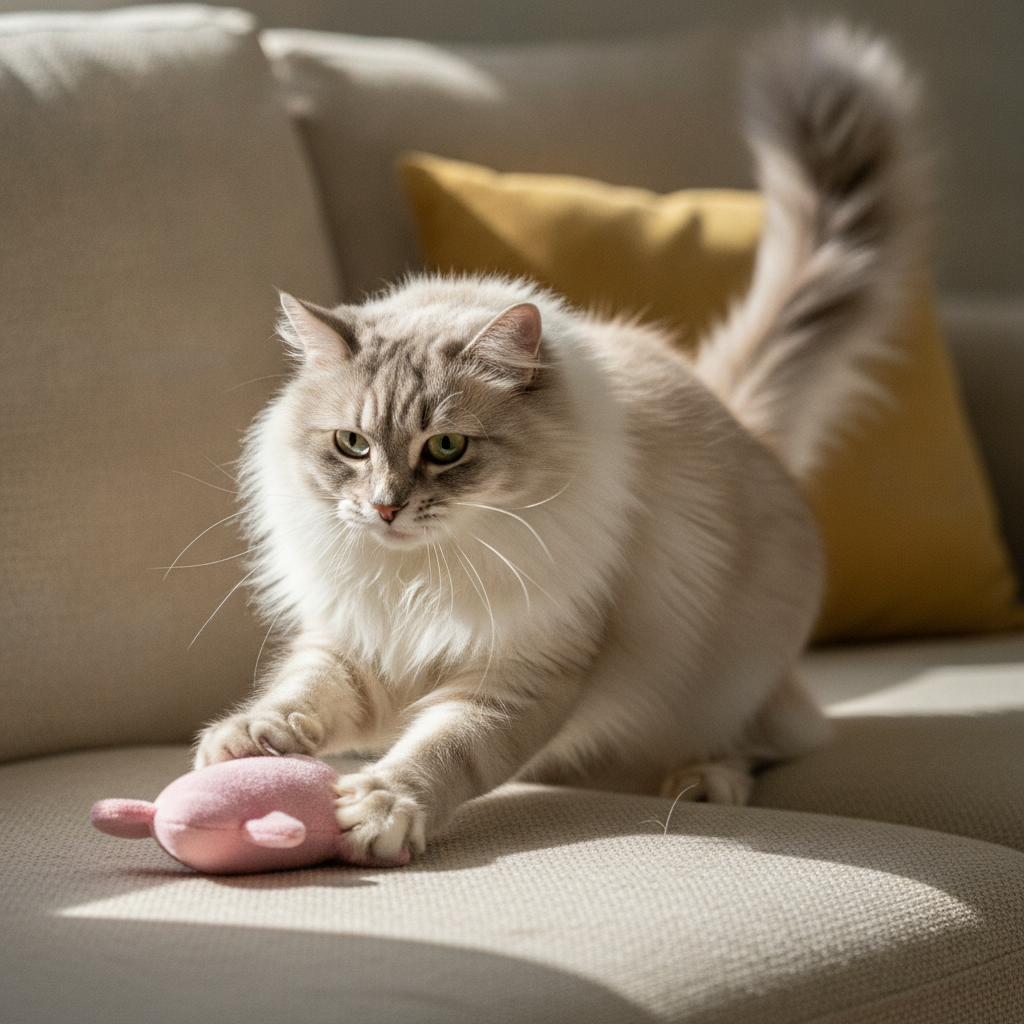
The crystal-infused cat toy is a beautifully honest product, just not in the way it is marketed. There are two things inside it. One of them has a peer-reviewed mechanism of action and a measurable effect on roughly half of all cats. The other one is a rock.
The rock is for you. That is not an insult, and it is not a reason to skip the toy. It is a reason to know which half you are actually buying.
What is in the thing
Merci Collective’s cat line, Happy Together, is a soft plush toy stuffed with dried catnip and a healing crystal, handmade in Los Angeles with recycled stuffing, around $18 direct from the brand. There is also a standalone rose quartz Crystal Catnip product.
Founder Chani Ronez has been open about the design thinking, and some of it is genuinely smart. The toy uses dried catnip rather than ground, so that as the cat bats and kicks it, the oils and fragrance keep getting crushed and re-released instead of going flat after one session. The standalone crystal product uses ground catnip, because it is more comfortable for a cat to chew on than the flowers.
The crystal sits at the center of the stuffing, wrapped in a soft fabric chosen to absorb the impact when a cat hurls the toy across a room. Ronez says she took the safety question to multiple veterinarians before producing it, and only went ahead once they signed off. Her reasoning on why it works for cats and would not for dogs is correct: cats do not chew toys the way dogs do. They bunny-kick and carry. A dog would try to destroy it.
Ronez grew up in Paris in a house that sometimes had eight cats in it at once, and she is candid that catnip is what fascinated her: an herb that can turn a cat’s world upside down, for the better, in seconds. She spent a long time studying it before building around it.
She was studying the right ingredient.
What catnip actually does
Catnip’s active compound is nepetalactone, one of a family of plant compounds called iridoids. When a cat encounters it, the response is stereotyped and unmistakable: sniff, lick, chew, rub the face and head into it, roll, and then a period of blissful vacancy.
For a long time this was filed under “cats are weird.” The current evidence says it is defensive chemistry. Research published in Science Advances found that rubbing and rolling in catnip transfers iridoids onto the cat’s face, head, and fur, and that those compounds repel mosquitoes. Later work found that when a cat chews and damages the leaves, the plant releases substantially more of the repellent compounds than an intact leaf does. The cat is not just getting high. The cat is applying bug spray.
That is the real story inside this toy, and it is far stranger and more delightful than anything a crystal is doing.
The part that stops half of cats cold
Here is the number the packaging will never tell you: only about 50 percent of cats respond to catnip at all.
The response is inherited. A cat who does not have the trait will sniff your $18 toy, decline to be transformed, and walk away, and there is nothing wrong with your cat and nothing wrong with the toy. This is also, incidentally, the explanation for most of the reviews that say “my cat ignored it.”
If you have one of those cats, the answer is not a different crystal. It is a different plant.
Silver vine (Actinidia polygama) works on roughly 80 percent of cats, including a large share of the ones who are immune to catnip. Research comparing the two found silver vine produced a response in far more cats, and free-roaming and captive cats alike prefer it for the rubbing-and-rolling behavior. Catnip releases roughly 40 times more total iridoids by volume, but silver vine reaches more cats. If catnip has failed at your house, silver vine is the single most likely thing to work, and it is usually sold as dried fruit powder or as chewable sticks.
Valerian and Tatarian honeysuckle round out the list of plants with documented feline responses, and are the next things to try after silver vine.
And the crystal?
There is no evidence that crystals affect animal behavior, anxiety, or physiology. There is no proposed mechanism that survives contact with physics, and there are no controlled studies in cats showing an effect.
The claims attached to specific stones, that rose quartz helps a pet with a rough past feel safe and trusting, that black obsidian eases separation anxiety, are marketing language and belief, not findings. If holding that belief makes you feel more connected to your cat, that is genuinely worth something. It is worth something to you. It is not treatment.
“The honest version of this product is a well-made catnip toy with a stone in it, and that is a perfectly good product,” says Dr. Lena Park. “The dishonest version is a cat with a real anxiety disorder whose owner spends six months charging a crystal instead of changing the environment or calling me. That delay is the harm.”
The safety question worth asking
The design does address the obvious risk: a solid object buried in the middle of a soft plush toy, cushioned against impact. Cats genuinely are not chewers the way dogs are, and the brand did consult vets. That is more diligence than most novelty pet products get.
That said, use the ordinary rules for any toy with a hard component inside it.
- Supervise the first few sessions. You are looking for a cat who chews rather than kicks, which is uncommon but not rare.
- Retire it when the seam goes. A plush toy with a stone in it is fine. A split plush toy with a loose stone on the floor is a foreign-body risk, particularly with a kitten in the house.
- Keep it away from the dog. This is a cat toy, and a dog will treat a crystal-filled plush the way a dog treats everything.
What to actually buy, in order
- A plain catnip toy first, as a test. Before spending on anything designed, find out whether your cat is in the responsive 50 percent. A cheap catnip mouse answers the question.
- If he responds: buy the nicer toy. Dried catnip beats ground for longevity, refillable beats sewn-shut, and the Happy Together toy’s construction is legitimately good. Yes, you are paying for the crystal. You are also paying for handmade construction, recycled stuffing, and a design that keeps releasing scent, and those are real.
- If he ignores it: switch plants, not products. Silver vine sticks or powder, then valerian. This is where the 50 percent of disappointed owners should be going.
- If the problem is actual anxiety: none of the above is the tool. Spraying, hiding, over-grooming, yowling, and litter box avoidance are signals, and they respond to environment (vertical space, more litter boxes, safe retreats, predictable routine), to behavior work, and sometimes to medication. Start with a vet visit to rule out pain and illness, because a cat in pain looks exactly like a cat with a behavior problem.
What newer research adds
The science on why cats do this has firmed up considerably, and it is on the catnip’s side of the toy, not the crystal’s.
The current view is that the whole rubbing-and-rolling ritual is functional: it coats the cat in mosquito-repelling iridoids, and cats damaging the leaves with their teeth increases the amount of repellent released. Newer work comparing plants has confirmed that cats, both housecats and free-roaming ones, actually prefer silver vine to catnip for this behavior, which is a strong practical hint for anyone whose cat is a catnip non-responder.
Nothing new supports the crystal half. That has not changed and, absent a mechanism, is not likely to.
Buy the toy because it is a good toy. Charge the crystal if it makes you happy. Just do not ask it to do the cat’s therapy.
References
- The characteristic response of domestic cats to plant iridoids allows them to gain chemical defense against mosquitoes — Uenoyama et al., Science Advances
- Domestic cat damage to plant leaves containing iridoids enhances chemical repellency to pests — iScience
- Responsiveness of cats (Felidae) to silver vine, Tatarian honeysuckle, valerian and catnip — Bol et al., BMC Veterinary Research
- Free-Roaming and Captive Cats Prefer Silver Vine to Catnip for Self-Anointing — Journal of Chemical Ecology
- Happy Together — Crystal & Catnip Cat Toy — Merci Collective