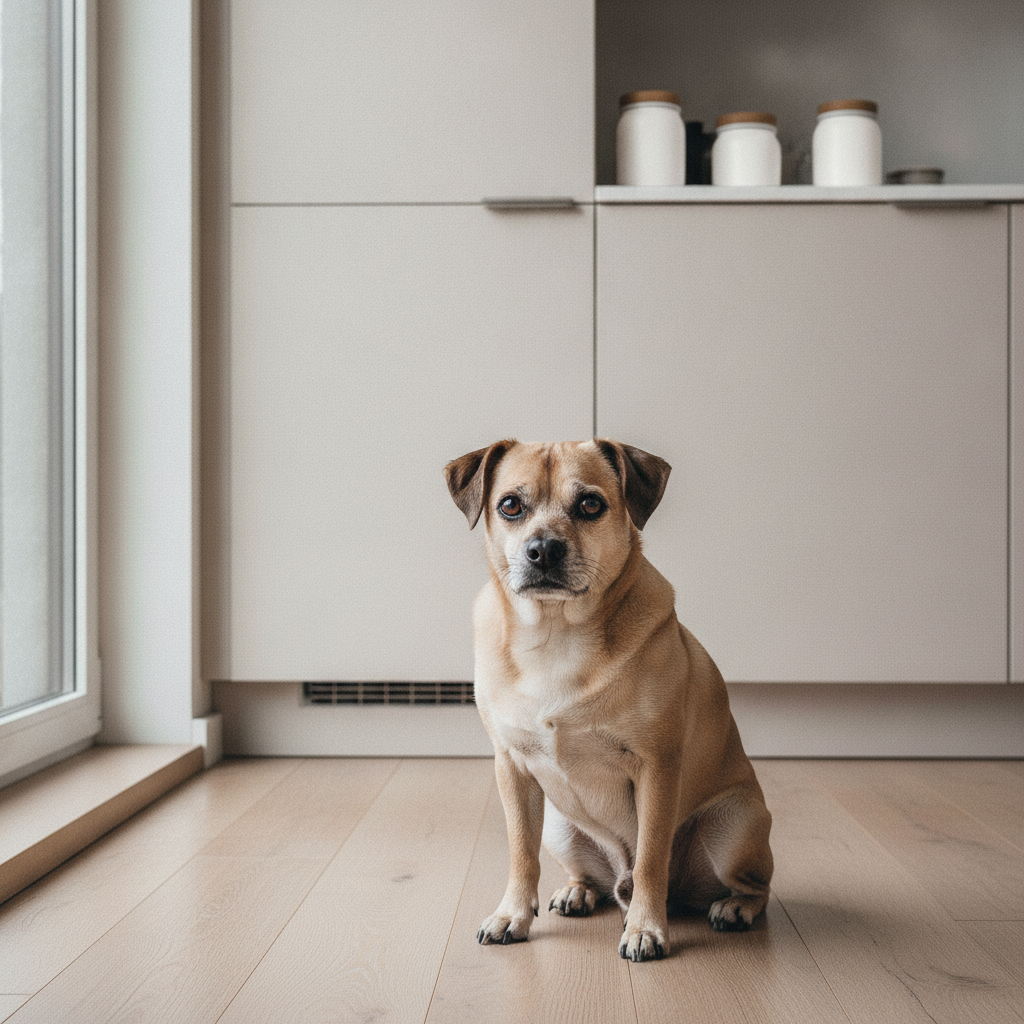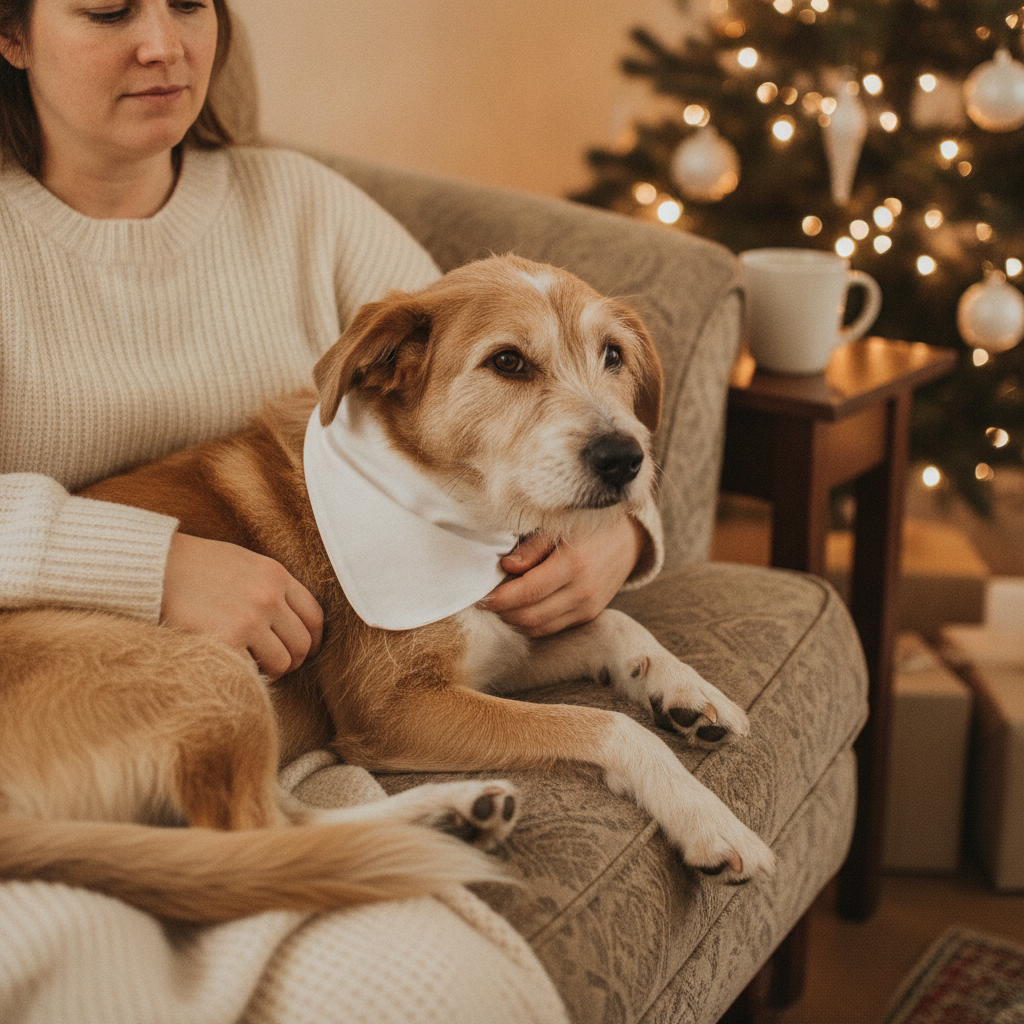
Your vet has just told you that your dog cannot run, jump, play, or climb stairs for six weeks. Maybe there was a cruciate repair. Maybe a disc. Maybe a soft-tissue injury that will heal cleanly if, and only if, nothing tears it open again.
You are now looking at a dog with a full tank of energy, a normal appetite for stimulation, and no way to spend either. And you are quietly certain that one of you is going to lose it before day forty-two.
Most people approach this as an endurance test. Get through it. Wait it out. That framing is why crate rest so often ends with a re-injury, a destroyed sofa, or a dog who has learned to bark for six weeks straight.
Here’s the better frame, and it’s the whole article: your dog has a daily requirement for mental work that doesn’t go away just because their body is on pause. It has to be spent somewhere. Your job for six weeks is to decide where.
Spent deliberately, it comes out as a tired, settled dog. Left unspent, it comes out as chewing, barking, pacing, and the frantic couch-launch that undoes the surgery.
Before anything else, get the restrictions in writing
Do this first, because almost everyone leaves the clinic with a vague instruction and fills the gaps with anxiety.
Ask your vet, specifically:
- Is a short leash walk permitted? How many minutes, how many times a day?
- Stairs: forbidden entirely, or allowed slowly on leash?
- Jumping on and off furniture: presumably no. Are ramps allowed?
- Can the dog stand and shift position freely, or do they need to be genuinely confined?
- Is swimming or hydrotherapy in play at any stage?
- Sitting up, lying in a particular position, or being carried: any constraints?
- When does the restriction step down, and to what?
People routinely assume the restriction is total when it isn’t. A permitted ten-minute sniff walk is worth a great deal, and a lot of dogs are allowed one from early on. Find out.
The budget, and seven ways to spend it
Aim for 20 to 30 minutes of genuine mental work a day, broken into chunks of five to ten minutes. Mental work tires dogs out in a way that surprises people the first time they try it. A dog who has solved problems for twenty minutes will sleep like a dog who has run.
Here are seven ways to spend the budget. You don’t need all seven. You need three or four that fit your dog, rotated so they stay novel.
1. Feed nothing from a bowl
The easiest win, and it costs you nothing.
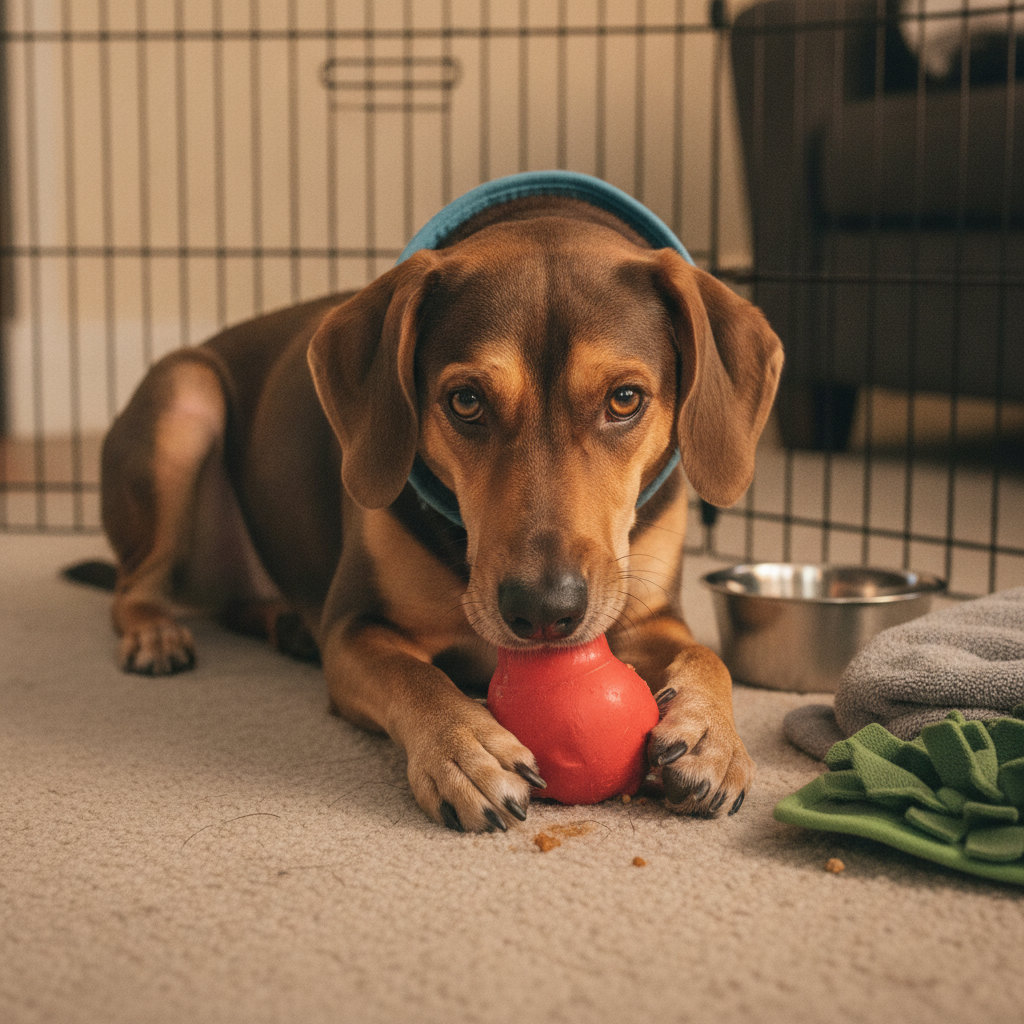
Your dog eats every day regardless. That meal is the largest untapped reservoir of engagement you have. Stop putting it in a bowl and start making them work for it: a stuffed rubber toy, a puzzle feeder, a snuffle mat, a treat-dispensing ball they can nose along the floor without needing to move much.
Freeze the stuffed toys. A frozen one takes three or four times as long, and a dog working a frozen Kong for forty minutes is a dog doing real cognitive and sensory work while lying down.
Rotate the vessels and change how you pack them. Same food, different problem, and the novelty is doing as much work as the food.
2. Run scent games from a lying-down position
Scentwork is the single best fit for a restricted dog, because a dog’s nose does the running while their body stays still.
Start with three cups on the floor, a treat under one, and let them indicate which. Progress to hiding food around the room while they’re out of sight and letting them find it, at a walk, on a leash if they get excited. For a dog on very tight restriction, hide treats inside a cardboard box stuffed with towels and let them excavate it while lying down.
This is exhausting for dogs. It engages an enormous amount of neural real estate. And it can be done almost entirely stationary.
3. Teach stationary tricks
Not spin, not rollover, not high-five if it means putting weight on the wrong limb. Ask your vet what’s safe, then pick tricks that don’t require the injured part.
Good stationary options for most restricted dogs: chin rest on your palm (also invaluable at the vet forever after), eye contact on cue, nose targeting your hand, “look at that” where they glance at an object and back at you, naming objects and picking the right one from a lineup.
Teaching a dog the names of five toys is a substantial cognitive project and can be done entirely from a mat.
4. Train a genuine settle
This is the one that pays off long after the six weeks are over.
Most dogs have never been taught how to be calm. They’ve only been prevented from being active, which is a different thing and feels awful.
Reward the dog for lying quietly on a mat. Start by paying them for two seconds of stillness, then five, then thirty. Pay calmly, deliver the treat between their paws so they don’t have to get up, and keep the whole affair boring. You are conditioning relaxation as a behavior that earns things, rather than as an absence of behavior.
Dogs who learn this during crate rest often keep it for life, and it’s one of the more valuable things a dog can know.
5. Give them a window and a schedule
Cheap, unglamorous, effective.
A dog on crate rest is bored in the specific way of someone with nothing to look at. Move the crate or pen somewhere with a view, if watching the street doesn’t wind them up. For dogs who bark at everything, the opposite: block the view and put on low, steady sound.
And keep a schedule. Meals, medication, enrichment, and sniff time at consistent times of day. A predictable day is a calmer day. Dogs handle constraint far better when they know what’s coming next.
6. Take the sniff walk seriously, if you’re allowed one
If your vet has cleared a short leash walk, do not waste it on getting from A to B.
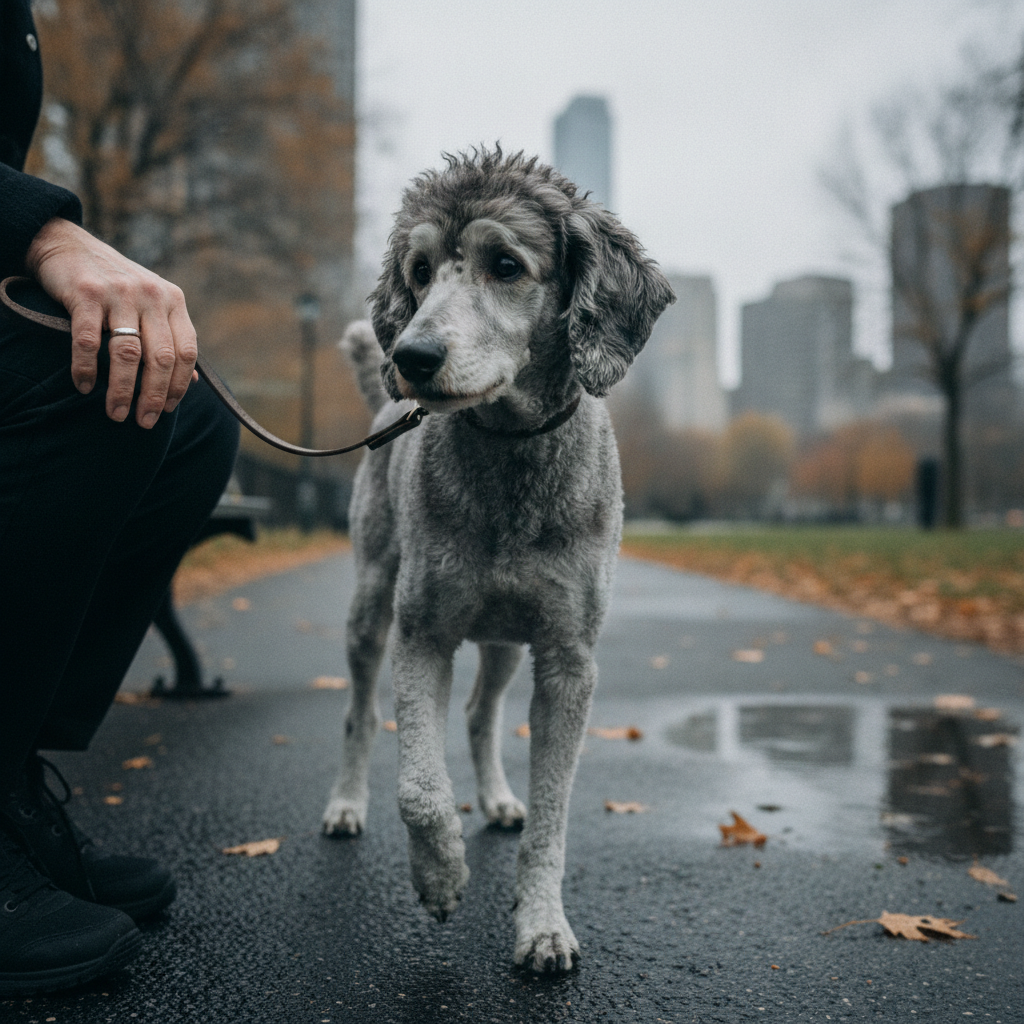
Ten minutes of standing still while your dog sniffs one patch of grass is worth vastly more than ten minutes of walking briskly around the block. Sniffing lowers arousal, gives the dog information, and is genuinely tiring. It’s also entirely compatible with a slow, controlled, low-impact walk.
Let them decide where to sniff. That’s the point. Your job is to hold the leash and be patient.
7. Manage the recovery itself, out loud
The most-skipped item and the one most likely to derail everything.
Set up the environment so that success doesn’t depend on your vigilance. Runner rugs down a slippery hallway. Baby gates at the stairs, in place before you need them, not after the first incident. A ramp to the couch, or the couch made inaccessible. Dog fed and toileted before you leave, so nobody’s improvising.
And be honest about medication. A dog in pain paces, whines, and can’t settle, and owners often read that as boredom and add more enrichment when what the dog needs is better analgesia. If your dog cannot settle at all, call your vet before you buy another puzzle toy.
“The most common thing I see go wrong in a six-week restriction isn’t boredom, it’s under-medicated pain that everybody reads as restlessness,” says Dr. Nina Kohl. “The dog can’t get comfortable, so they shift and pace and whine, and the owner concludes they need more to do. Get the pain control right first. A comfortable dog will actually use the enrichment you give them.”
Two weeks in, when it gets ugly
There’s a predictable trough. The dog feels better before they are better, and they start to protest the restriction. Barking. Chewing the pen. Trying to launch off the bed the second your back is turned.
This is the highest-risk moment of the whole recovery, precisely because the dog now feels well enough to hurt themselves.
Do not relax the rules. Do turn up the enrichment, add a mid-day session if you can, and check that pain control is still appropriate, because a dog who’s stopped taking their medication is often a dog who’s suddenly more mobile and more likely to re-injure.
Get help if you need it. A dog walker who will sit and do a puzzle session, a neighbor who’ll do the lunchtime Kong, a trainer who can run a couple of remote sessions. Six weeks is a long time to do alone, and burnt-out owners cut corners.
What newer research adds
The strongest recent development in this area is the mainstreaming of canine rehabilitation as a discipline. Certified rehab practitioners now offer structured, veterinarian-supervised programs, underwater treadmill work, controlled therapeutic exercise, laser and manual therapy, that are built specifically around a restriction.
That matters because it changes the shape of the six weeks. Rather than a flat period of nothing followed by an abrupt return to normal, you get a graded reintroduction of load, which is both faster and safer. Ask your vet whether a rehab referral is appropriate for your dog’s specific injury. For cruciate repairs and disc disease in particular, it increasingly is.
The other thing worth knowing: sleep is doing more work than you think. Recent polysomnography research in dogs shows that sleep quality is genuinely poorer when a dog is stressed or away from their person, and that disrupted sleep degrades learning and emotional processing the next day. A dog on crate rest who cannot rest properly is recovering worse on every axis. Where they sleep, how quiet it is, and whether they feel safe there are part of the medical plan, not a comfort detail.
FAQ
How much mental exercise should replace the physical exercise? Aim for 20 to 30 minutes of real problem-solving a day, in short chunks. It’s more tiring than most people expect.
Can I still walk my dog at all? Ask your vet, specifically, and get a number of minutes. Many restrictions permit short, slow, on-leash walks, and a permitted sniff walk is one of the best tools you have.
My dog won’t stop barking in the crate. What now? Check pain control first, then check boredom, then work on the settle. Barking that starts abruptly a couple of weeks in is very often a dog who feels better and hates the confinement.
Is a puzzle feeder really enough to tire a dog out? For a lot of dogs, yes, more than you’d guess. Freeze the stuffing, vary the vessel, and use their actual meals rather than extra food on top of them.
References
- “Canine Rehabilitation and Physical Therapy.” American Association of Rehabilitation Veterinarians. https://www.rehabvets.org/
- “Postoperative Care for Orthopedic Patients.” American College of Veterinary Surgeons. https://www.acvs.org/small-animal/
- Duranton, C., and Horowitz, A. “Let me sniff! Nosework induces positive judgment bias in pet dogs.” Applied Animal Behaviour Science, 2019. https://www.sciencedirect.com/science/article/abs/pii/S0168159118304489
- “Family Dogs’ Sleep Macrostructure Reflects Worsened Sleep Quality When Sleeping in the Absence of Their Owners: A Non-Invasive Polysomnography Study.” PubMed Central, 2025. https://www.ncbi.nlm.nih.gov/pmc/articles/PMC12608857/
- “Intervertebral Disc Disease.” American College of Veterinary Surgeons. https://www.acvs.org/small-animal/intervertebral-disc-disease/