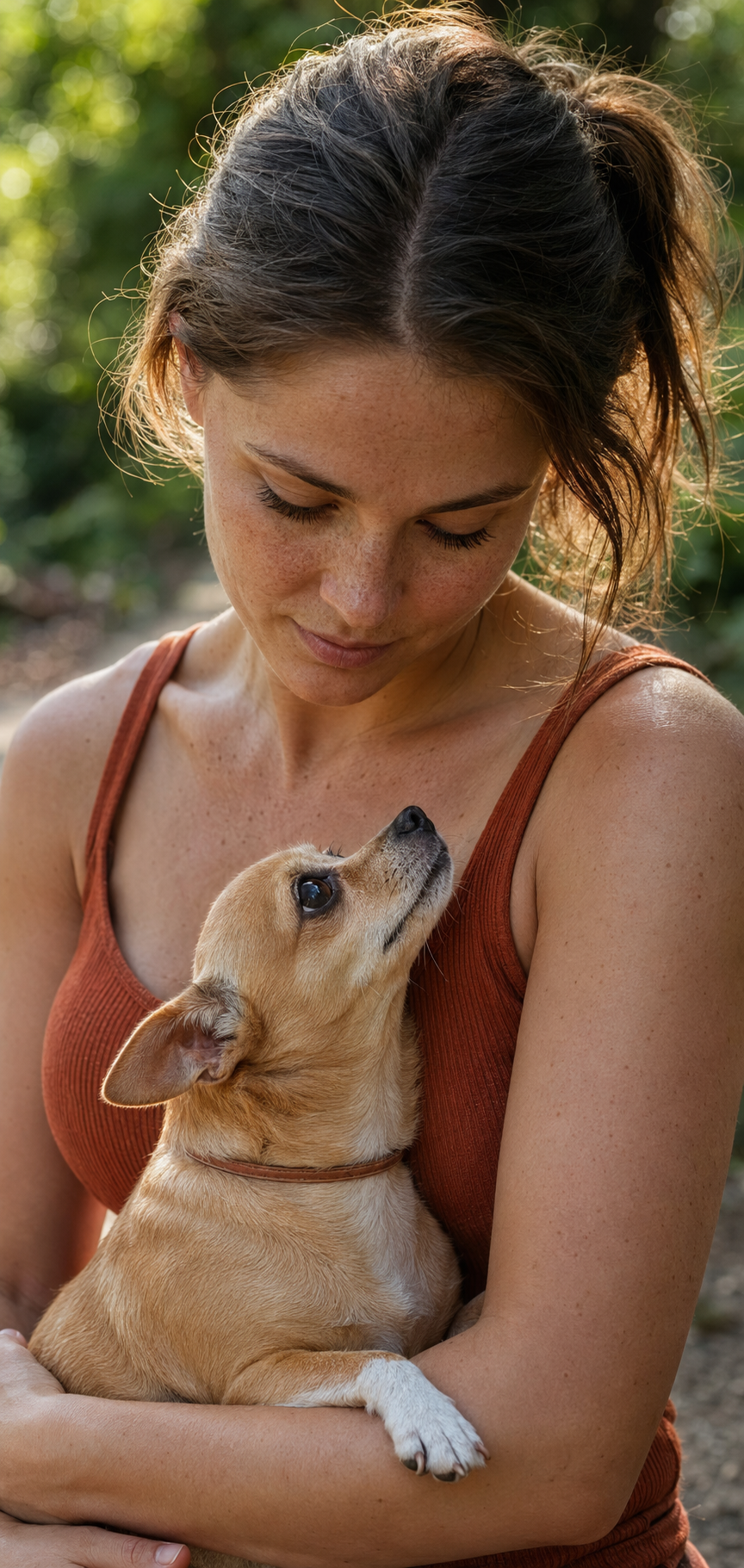
You’ve seen the videos, even if you didn’t go looking for them: someone doing a full morning makeup routine while a Chihuahua the size of a dinner roll rides shotgun in a hoodie pouch, watching every stroke of mascara like it’s the most important event of the day. To a Chihuahua person, this is just Tuesday. Head to the front door and they’ve beaten you there. Start cooking and they’re underfoot, ready to supervise. Step into the shower and, well, why wouldn’t they want a front-row seat?
At some point every Chihuahua owner wonders the same thing: why is this five-pound animal so completely, relentlessly obsessed with me? The answer isn’t insecurity, and it usually isn’t a problem to fix. It’s what the breed is for.
The clinginess is the whole point
First, the reassuring part: you’re not imagining it, and it’s not a quirk of your dog specifically. Chihuahuas as a breed are wired to orbit their people — following from room to room, insisting on contact, and getting visibly unsettled when their person walks out of reach.
To understand why, it helps to think about what other breeds were made to do. Dogs have spent centuries being shaped for jobs. A terrier bred to hunt rats treats a scurrying anything as a personal mission. A hound bred to track lives for the scent. Those dogs carry a purpose in their bones. The Chihuahua’s purpose just happens to be a person.
“We tend to read ‘clingy’ as a flaw, but for a Chihuahua it’s closer to a vocation,” says Dr. Mara Chen, a veterinary behaviorist who consults for The Pet Times. “Working breeds were selected to herd or guard or hunt. Chihuahuas were selected, over a very long time, to want to be near us. Sticking close isn’t anxiety in most of them — it’s the trait doing exactly what it was bred to do.”
In other words, a herding dog can’t help gathering things and a scent hound can’t help following its nose, and your Chihuahua can’t help appointing itself your personal shadow. Generations of breeding for pure companionship left them preferring, above almost anything, to be with their human and to keep that human in sight or in reach.
Being tiny changes the math
There’s a second force at work, and it’s simple physics. Chihuahuas are minuscule compared to nearly everything around them. They’ll bluff and posture to seem bigger, but at the end of the day they are barely more substantial than a large mouse in a world full of things that could step on them.
Small size comes with a small animal’s caution. Prey species survive by hiding, and a dog that weighs less than a bag of sugar has good reason to feel exposed in a crowd of larger dogs and clomping human feet. Sticking to you isn’t just affection, then — it’s a safety strategy. You are the safest, warmest, highest ground available.
That’s why so much of raising a confident Chihuahua comes down to helping them feel secure rather than scolding them for being scared. In a chaotic or crowded setting, don’t expect a Chihuahua to stride bravely among animals ten times its size — pick them up and let them watch from a safe perch. At home, scatter a few small beds around the house so they always have a spot that’s theirs to retreat to. Little dogs relax when they have a den to call their own, and a settled dog is a braver dog.
When closeness tips into anxiety
Here’s where the lovely part can curdle. A dog bred to be with you, and small enough to carry everywhere, is a dog that may never learn how to be alone — and separation anxiety is genuinely common in the breed.
The symptoms aren’t subtle once you know them: trembling, whining, howling, house-soiling from a normally clean dog, and frantic scratching or clawing at doors when you leave. The cruel irony is that the very things that make Chihuahuas so easy to keep close — their portability, their eagerness to be carried — are what set them up to struggle. A dog that’s rarely put down rarely practices being on its own.
“The most anxious Chihuahuas I see are often the most doted-on,” Dr. Chen says. “They’ve almost never had to sit with being alone, so the first time they do, it’s overwhelming. The fix isn’t loving them less. It’s building tiny, boring, everyday experiences of separation early, so alone-time is a familiar thing and not a crisis.”
Two practical points follow from that. First, start separation training early and keep it low-drama: brief, calm departures and returns that teach your dog you always come back. Second, let them touch grass — literally. A dog carried everywhere, whether in your arms or a bag, never gets to build confidence on its own four feet, and constant carrying can leave an already nervous dog feeling more fragile, not less. The reassuring news is that Chihuahuas are curious, resilient, and eager to please, so with consistent, positive training, they learn to thrive both with you and without you. Independence when it’s needed doesn’t erase the bond; it just means the bond isn’t a cage.
What newer research adds
If the depth of your Chihuahua’s attachment sometimes startles you, science has been catching up to what you already feel. Researchers studying the dog-human bond increasingly describe it in the language of attachment — the same secure-base dynamic seen between a young child and a parent, where the trusted person becomes the anchor that makes exploring the world feel safe. That framing helps explain why a companion breed like the Chihuahua leans on proximity so hard: you’re not just company, you’re their base of operations.
The practical upshot lines up with everything above. Attachment is healthy; over-dependence isn’t. The goal isn’t to loosen the bond but to make it secure enough that your dog can leave the base, poke around on its own, and come back — rather than falling apart the moment the base walks out the door.
Bottom line
A clingy Chihuahua isn’t broken or spoiled. It’s a companion breed doing precisely what generations of breeding designed it to do: keeping tabs on the person it adores, made a little more anxious by the reality of being very small in a very big world. Lean into it — give them safe perches, cozy dens, and plenty of contact — but pair that closeness with early, gentle practice at being alone, so your shadow can also stand on its own. And yes, maybe buy the sling. They’d feel terrible missing your morning routine.
If your Chihuahua’s distress when alone is severe — destruction, nonstop vocalizing, panic — loop in your veterinarian or a behavior professional, since separation anxiety is a treatable condition, not a life sentence.