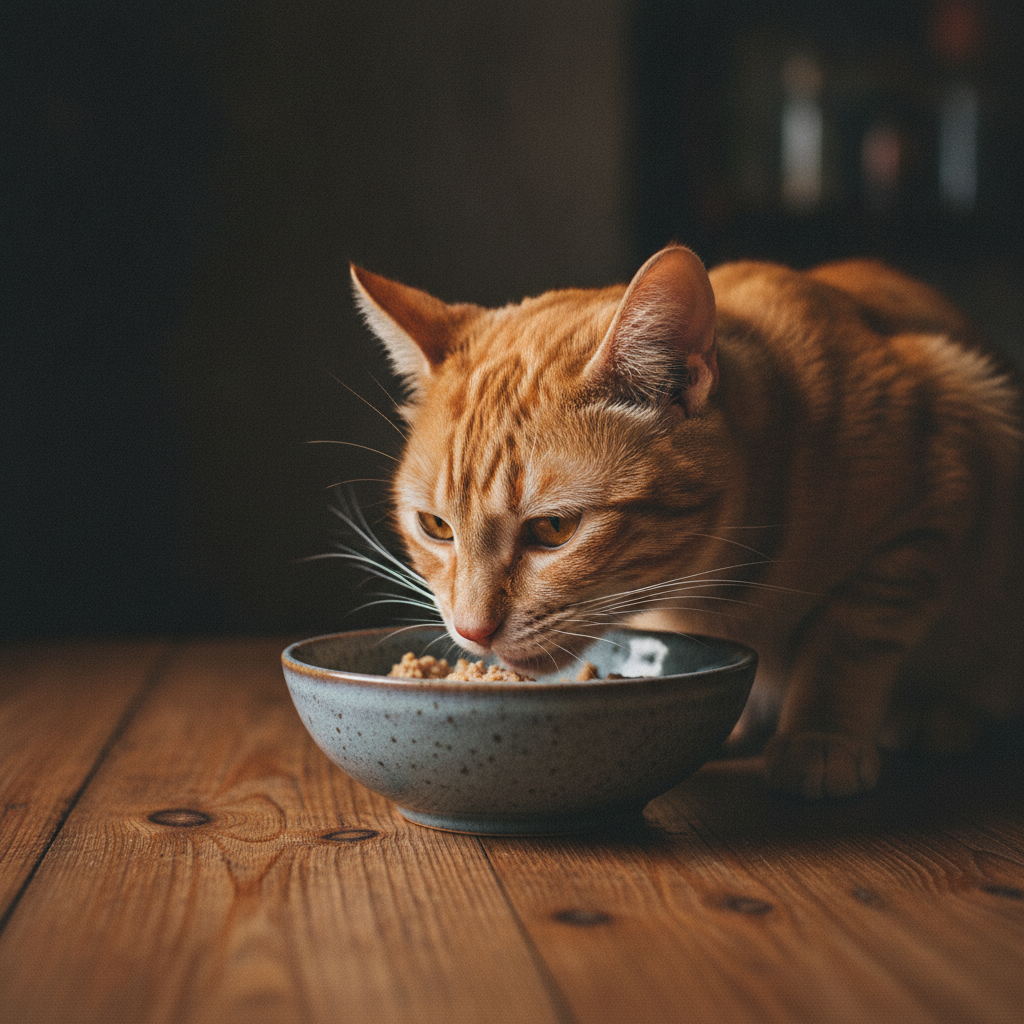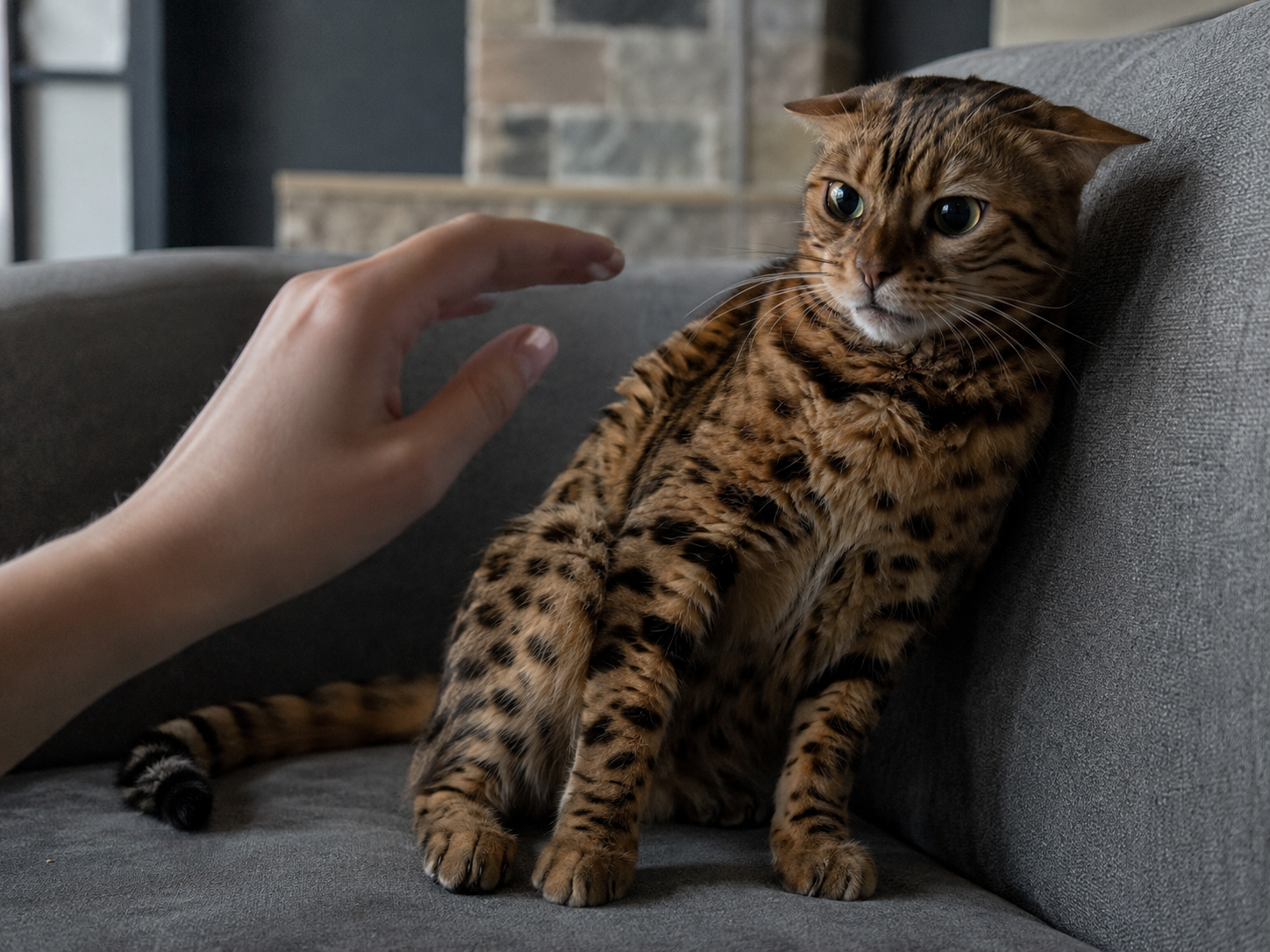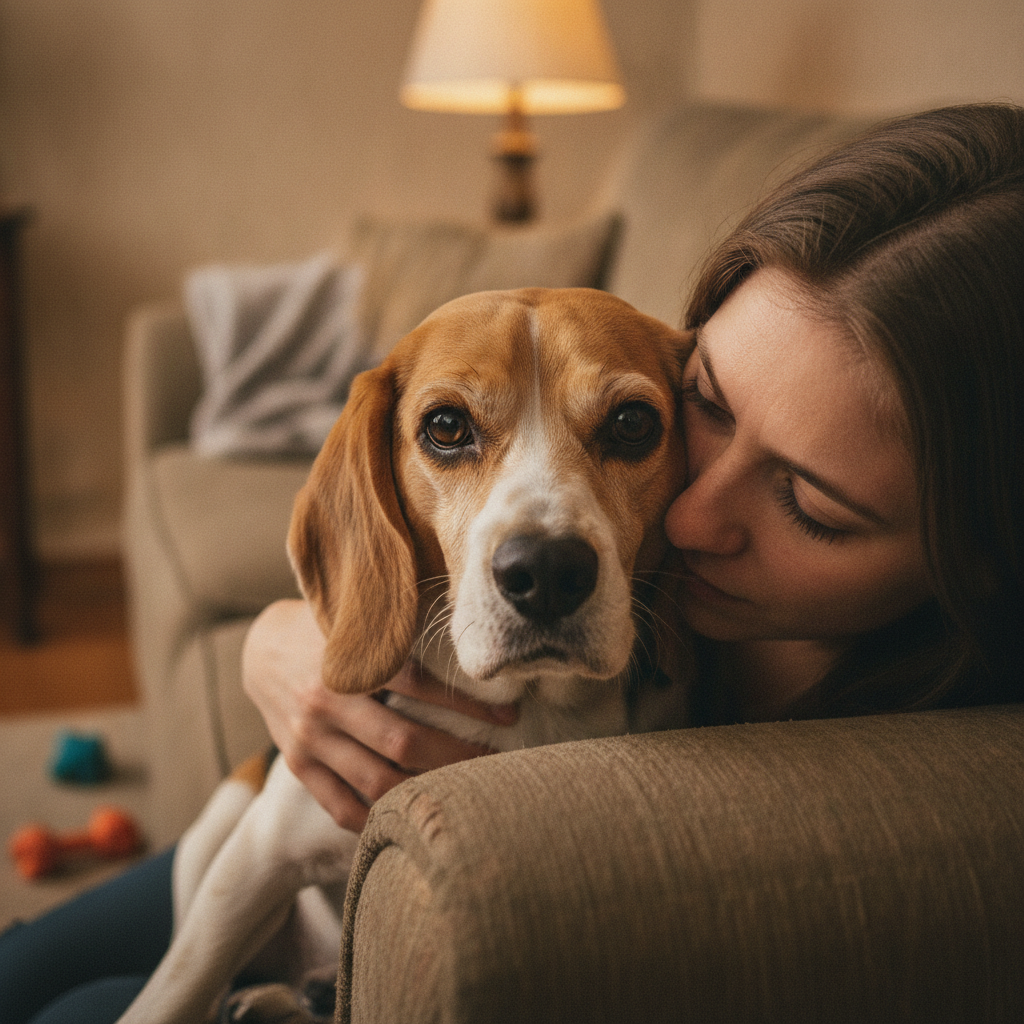
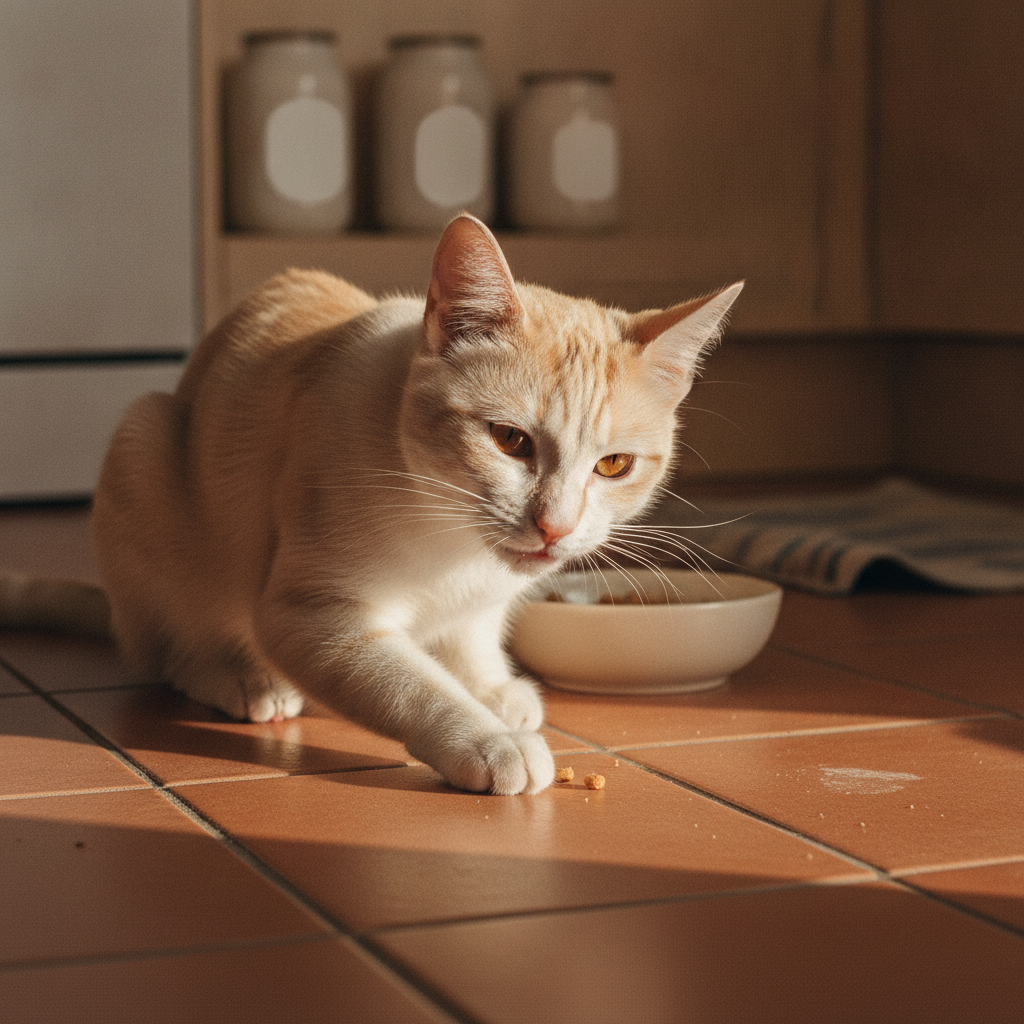
There is a small pile of kibble on your kitchen floor, about eight inches from a perfectly good bowl of kibble. Your cat put it there. She then ate it off the tile with the air of someone who has solved a problem.
The temptation is to file this under Cats Are Strange and sweep it up. That is a missed message. This behavior is not random, and it is very rarely meaningless. Nine times out of ten your cat is not being difficult, she is submitting a review of the feeding station you built, and every category of that review is something you can fix in an afternoon.
Here is how to read it.
She is reviewing the company
Cats are social animals who are not social eaters. That distinction gets lost constantly, because we know that cats bond, cuddle, groom each other, and seek us out, and we conclude that a shared mealtime is a happy one.
In the wild, a cat’s ancestor hunts alone and eats what she catches alone, because anything that shows up while she is eating is either competition or a threat. A domestic cat still runs on that operating system. Line two or three of them up shoulder to shoulder at a row of bowls and you have not created a family dinner, you have created a standoff. The cat lowest in the pecking order will frequently solve it by taking her portion somewhere defensible, which is to say under the couch.
The fix is embarrassingly simple: separate them. Not by a foot. By a room, or at minimum by enough distance and visual break that no cat can see another cat’s face while she eats. If you have a dog, that goes double, and it goes triple if the dog has ever helped himself to the cat’s dinner.
She is reviewing the room
Now look at where the bowl sits. Not with your eyes, with hers, at ankle height, in a body that weighs nine pounds and cannot lock a door.
A dish parked in a high-traffic corridor of the kitchen means eating with feet swinging past, a dishwasher grinding, a toddler at full volume, and no line of sight to whatever is coming next. Some cats shrug this off. Anxious cats do not. They eat in nervous bursts, or they take the food somewhere quiet, or, in the worst version, they eat less than they need and slowly lose weight while everyone assumes they are just picky.
A feeding station wants a low-traffic spot, a wall at the cat’s back, a clear view of the room’s entrance, and distance from the litter box (nobody wants to eat next to a toilet). If your cat’s dish is currently in the busiest square foot of your home, move it before you change anything else.
She is reviewing the dish
Sometimes the bowl itself is the whole story.
Material matters more than people expect. Plastic is the common culprit and the one worth eliminating. It scratches easily, and those scratches hold odor and bacteria that ordinary washing does not fully remove, which is exactly why plastic cutting boards fell out of favor in kitchens. In some cats, the contact also triggers chin irritation and feline acne, those stubborn little blackheads under the jaw. Stainless steel and food-safe glazed ceramic are the sensible defaults. That said, preferences are individual and occasionally maddening: there are cats who refuse steel, and if your cat is one of them, arguing with her is not a winning strategy.
Shape matters just as much. A deep, narrow bowl forces a cat to push her face down into a well while her whiskers drag along both walls. Whiskers are dense with nerve endings and exist to read the world by touch, so the theory goes that this constant brushing is unpleasant enough to make a cat back out and take her food elsewhere. The theory has a name, whisker fatigue, and it has run far ahead of the evidence. The behavior research is genuinely unsettled on whether it bothers cats much at all.
But notice that the disagreement does not change what you should do, because the fix is free. A wide, shallow dish with plenty of room around the food costs no more than a deep one, and it removes the variable entirely. Buy the wide bowl and stop thinking about it.
She is reviewing the food
Here is the one people miss, and it is the reason this behavior spikes when a treat is involved.
Watch what happens when you hand a cat a piece of chicken, or a chunk of tuna, or anything meaningfully larger than a piece of kibble. She takes it out of the dish immediately. That is not guarding and it is not drama. It is mechanics. A cat cannot easily hold, tear, and reposition a large piece of food inside a bowl. She needs a flat surface and some elbow room, so she gets one. The floor is a plate.
If the habit only appears with people food and big soft pieces, congratulations, there is nothing to fix. Cut the pieces smaller if the mess bothers you, or put down a mat and accept that you are dining with a small predator.
And there is one more benign version: play. Some cats, especially on hard floors, will bat kibble around before eating it, chase it, trap it, and then finally consume it. That is the hunting sequence running in a house where nothing needs to be hunted. It is a good sign, not a bad one. If the mess is the problem rather than the behavior, put the calories into a puzzle feeder and let her work for the meal on purpose.
The five-day test
The mistake is changing four things at once and never learning which one mattered. Move one variable at a time and give each about five days, because a cat’s opinion of a new arrangement is not visible on day one.
- Move the bowl to a quiet, low-traffic spot with a wall behind it. Change nothing else.
- Separate the animals, so nobody eats within sight of anybody else.
- Swap the dish for a wide, shallow one in steel or glazed ceramic.
- Shrink the pieces, if the habit is specific to treats and human food.
- Add a puzzle feeder, if what you are actually watching is play.
Somewhere in that list is your answer, and you will know which one it was.
The version that is not about the bowl
Almost all of this is harmless. One version is not.
If a cat who has eaten neatly out of a dish for years suddenly starts carrying food out, or dropping it, or chewing on one side of her mouth, the first suspect is her mouth. Dental disease is extraordinarily common in cats and extraordinarily easy to miss, because a cat in pain does not complain, she adapts. Estimates from the Cornell Feline Health Center put dental disease in somewhere between half and 90 percent of cats over the age of four.
“Cats hide oral pain better than almost any patient I see, and the tell is rarely dramatic,” says Dr. Ravi Mehta. “It is a change in how they eat, not whether they eat. A cat who suddenly takes food somewhere else, drops half of it, or turns her head to chew on one side is telling you her mouth hurts, and by the time we look, there is usually something in there that has hurt for a while.”
The red flags that turn a quirk into an appointment: the behavior is new, the food gets dropped rather than eaten, there is drooling, pawing at the face, or bad breath, she has stopped grooming, or she is losing weight. Any of those, call your vet rather than rearranging the furniture.
What newer research adds
Two things have shifted in the last few years, and both should make you more relaxed and slightly more attentive at the same time.
The first is that whisker fatigue, which spread widely as settled fact, has not held up as settled fact. Recent reviews of the evidence find the support for it thin and the question genuinely open. The advice built on top of it, use a wide shallow dish, is still perfectly good, so nothing you do changes. But be skeptical of products sold to you on the strength of it.
The second is that veterinary medicine keeps finding feline dental disease earlier and more often than anyone expected, which is why the “when to worry” list above is worth taking seriously even though this behavior is usually nothing. The quirk is almost always a quirk. It is the change in the quirk that matters.
References
- Cornell Feline Health Center, Feline Dental Disease
- Robbins, M.T., et al. “A Scoping Review of the Evidence for the Existence of ‘Whisker Fatigue’ in Domestic Cats.” Animals, 2024.
- VCA Animal Hospitals, Chin Acne in Cats
- American Association of Feline Practitioners, Feline Environmental Needs Guidelines