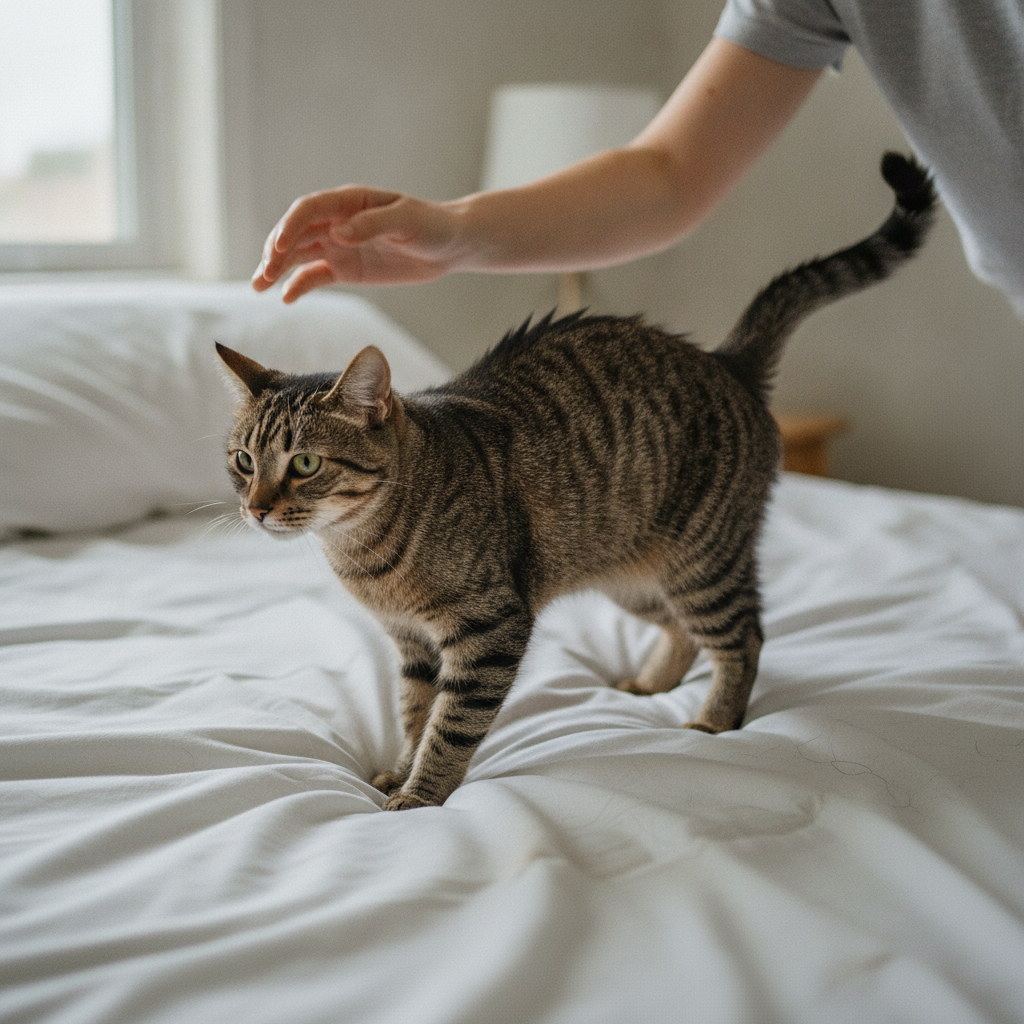
You run a hand down your cat’s spine and the skin does something faintly unsettling: it rolls. A wave passes along the back, the tail whips, and the cat gives you a look that suggests you have committed a crime.
Most of the time, that’s a muscle doing exactly what it evolved to do. Cats have a thin sheet of muscle, the cutaneous trunci, that sits under the skin along the trunk and can move the skin independently of the body beneath it. It exists so a cat can shake off a fly without turning around. When you touch the back, it fires. That’s the whole event.
The problem is that a handful of genuinely serious things produce the same ripple, and one of them is a syndrome so defined by this behavior that it’s nicknamed “twitchy cat syndrome.” So the useful skill isn’t identifying the twitch. It’s knowing where the line is.
Where the line is
Here’s the sorting rule, and everything below is elaboration on it.
A normal twitch is a response. An abnormal twitch is an event.
A response has a cause you can point to: you touched them, a fly landed, a bird appeared at the window. It’s brief, proportionate, and the cat carries on with their life.
An event has no trigger, or a trigger wildly out of proportion to the reaction. The skin ripples for thirty seconds with nobody touching the cat. Or you brush the lower back and the cat screams, spins, bites at their own tail, and bolts from the room.
The second one is what sends people to the vet, and it should.
What the twitch looks like, and what to watch alongside it
The twitch itself ranges from a subtle ripple of skin under your hand to visible muscle spasms that continue for half a minute or more with no stimulation at all.
What matters more is what your cat does about it. Some cats don’t seem to notice. Others react as though you’ve assaulted them. That reaction is your best clue.
Watch for:
- Signs of pain: crying out, reluctance to jump, hesitating at the litter box lip, stiffness, or not wanting to be touched at all
- Excessive grooming or licking, especially fixated on one spot, especially the lower back, flank, or tail base
- Self-directed aggression: biting at the flank or chasing and attacking the tail
- Behavior changes: hiding, clinginess, or a sudden refusal of contact
- Whole-cat signs: appetite change, weight loss, drinking more, coat quality dropping
Seven reasons your cat’s back twitches
1. It’s just a normal reflex
The most common answer. You petted them and they didn’t love it. A fly landed. A bird appeared and the whole cat came online, back rippling, tail flicking. Cats also twitch in their sleep. All normal, all uninteresting.
2. Fleas and flea-allergy dermatitis
This one belongs high on the list and gets left off constantly.
A single flea bite is enough to set off intense itching in a sensitized cat, and the classic distribution of flea allergy dermatitis is exactly where owners notice the twitch: the lower back, the tail base, and the back of the thighs. The cat twitches, then whips around to lick or bite the spot, then twitches again.
You will often not see fleas. Cats groom them off. What you’ll see is flea dirt (specks that turn rust-red on a damp paper towel) and small scabby bumps.
If your cat twitches along the back and is over-grooming their rump, check for fleas before you go anywhere near a neurological explanation. This is far and away the most common treatable cause, and it’s fixed with a proper vet-recommended parasite preventive, applied to every animal in the house, every month, year-round.
3. Pain or spinal discomfort
Under the skin there are muscles, vertebrae, and the spinal cord. Injury or disease in any of them can produce back pain, and back pain produces twitching.
A painful cat looks stiff. They stop jumping to places they used to reach. They may not want to move much at all, they may skip the litter box because climbing in hurts, and they may cry out or bite if you touch the back. Arthritis in the spine is common in older cats and dramatically underdiagnosed.
If your cat’s twitch comes with any reluctance to move, that’s a vet visit, not a wait-and-see.
4. Skin conditions
Skin does a lot of work: it keeps the outside out, regulates moisture and temperature, and senses touch. When it’s inflamed, infected, dry, or reacting to an allergen, it produces exactly the tingling, prickling discomfort that drives twitching.
Food allergy, environmental allergy, ringworm, bacterial infection, and dry-air dermatitis all belong here. Skin problems escalate quickly once a cat starts self-traumatizing, so this is worth a call rather than a month of watching.
5. Mild seizures
Not every seizure is the dramatic version. Focal seizures can be extremely subtle: a rippling along the back, rapid blinking, facial twitching, a brief unresponsive stare. Seizures come from disrupted electrical activity in the brain and always warrant a workup.
One critical safety point: dog flea and tick products can cause seizures in cats. Permethrin-based products in particular, which are safe for dogs and sold everywhere, are toxic to cats. Never apply a dog product to a cat, and be careful about a treated dog and a cat sharing a bed.
6. Hyperthyroidism
The thyroid is a small gland in the neck that mostly goes unnoticed until it starts overproducing hormone. Hyperthyroid cats classically lose weight while eating ravenously, and they’re often restless and hyperactive. Muscle twitching, including along the back, can be part of the picture.
It’s common in older cats, it’s diagnosed with a straightforward blood test, and it’s treatable. If your twitching cat is over ten, eating a lot, and getting thinner, ask for thyroid bloodwork.
7. Feline hyperesthesia syndrome (FHS)
The one with the name.
FHS is a syndrome of oversensitive skin, most often over the back and lumbar region. Affected cats may twitch dramatically, ripple, vocalize, bolt, over-groom, bite at their own flank or tail, and sometimes become aggressive when the back is touched. Episodes come and go. Between them, the cat may look completely normal.
It is not fully understood. Current thinking is that it sits at the intersection of skin disease, spinal or nerve dysfunction, pain, and anxiety, and that different cats arrive at it by different routes. Which is precisely why the treatment is rarely a single pill.
“Hyperesthesia isn’t really one disease, and treating it like one is why people get frustrated,” says Dr. Lena Park. “I’ve had cats whose entire syndrome resolved when we finally got the fleas under control, and others where the skin was fine and the whole thing was pain and anxiety wearing a costume. You have to be willing to work the list.”
Normal ripple vs. hyperesthesia: the practical difference
| Normal twitch | Hyperesthesia | |
|---|---|---|
| Trigger | Touch, insect, prey sighting | Often none, or a light touch |
| Reaction | Brief ripple, maybe a tail flick | Overreaction: vocalizing, bolting, biting the flank or tail |
| Frequency | Occasional | Repeated episodes |
| Aftermath | Cat carries on | Cat over-grooms, hides, or seems distressed |
| Self-injury | None | Common, especially to the tail |
How it’s diagnosed
There’s no test for FHS. It’s a diagnosis of exclusion, which means your vet has to rule out everything else first, and you should expect that to take more than one visit.
Expect: a thorough skin exam and parasite check, bloodwork (including thyroid), possibly imaging of the spine, and often a request that you keep a journal of the episodes. That journal is more useful than people realize. Note the time, what was happening right before, how long it lasted, and what your cat did afterward. Patterns show up in writing that nobody notices in real time.
What newer research adds
Two things landed in 2025 that change the practical picture.
First, on treatment. A study in the Journal of Veterinary Internal Medicine followed 28 cats with hyperesthesia syndrome to look at long-term response to different approaches. The cats were managed in three broad ways: fluoxetine alone (about 57%), behavioral modification combined with gabapentin or fluoxetine (about 25%), and behavioral modification alone (about 18%).
The headline for owners is that this is a condition where medication and environment are both on the table, and combined approaches were a substantial part of what was actually being done in practice. If your vet suggests an anti-anxiety medication for a skin condition, that is not a brush-off. It’s consistent with where the evidence is.
Second, on triggers. A 2025 case report in Veterinary Record Case Reports documented scent as a trigger for a hyperesthesia episode. That’s a single case, so hold it loosely, but it’s a genuinely useful prompt: if your cat’s episodes cluster around a particular room, a cleaning product, a plug-in diffuser, or a new laundry detergent, that’s worth writing in the journal and mentioning.
Both of those point the same direction. FHS management is multimodal. Nobody is going to hand you one pill and send you home, and if the first thing your vet does is treat for fleas and re-check in a month, that’s not them dodging the question. That’s them starting with the most likely answer.
Bottom line
Occasional back twitching is normal cat hardware working normally. It needs no intervention and no worry.
The twitch becomes a symptom when it stops being a response and starts being an event: unprovoked, out of proportion, frequent, or paired with pain, over-grooming, self-directed biting, weight loss, or a change in appetite.
Start with fleas. Then pain. Then the rest.
FAQs
Is hyperesthesia in cats serious? It isn’t fatal, but it’s usually a lifelong condition that needs ongoing management rather than a one-time cure. Working closely with your vet to find the right combination of treatment and environmental changes is what gets it under control.
Why does my cat’s skin ripple when I pet them? Cats have a layer of muscle under the skin along the back that can move independently. Touching that area triggers it. An occasional ripple is normal, especially if your cat wasn’t enjoying the petting.
Will hyperesthesia resolve without treatment? Episodes can come and go, but the underlying condition doesn’t clear up by itself. It requires management.
Could it just be fleas? Very often, yes. Flea allergy dermatitis concentrates on the lower back and tail base, exactly where owners notice twitching, and cats groom the fleas away so you may never see one. Rule this out first.
When should I take my cat to the vet for back twitching? When it happens without any trigger, when the reaction is dramatic, when it’s becoming frequent, or when it comes with any pain, over-grooming, self-biting, appetite change, weight loss, or reluctance to jump.
References
- “Hyperesthesia Syndrome.” Cornell Feline Health Center, Cornell University College of Veterinary Medicine. https://www.vet.cornell.edu/departments-centers-and-institutes/cornell-feline-health-center/health-information/feline-health-topics/hyperesthesia-syndrome
- Pauciulo, S., et al. “Long-Term Clinical Response to Medical Treatment, Behavioral Therapy, or Their Combination in Cats With Hyperesthesia Syndrome.” Journal of Veterinary Internal Medicine, 2025. https://doi.org/10.1111/jvim.70174
- McPeake, K., et al. “Scent as a Trigger of Feline Hyperaesthesia Syndrome.” Veterinary Record Case Reports, 2025. https://doi.org/10.1002/vrc2.1059
- “Hyperthyroidism in Cats.” Cornell Feline Health Center, Cornell University College of Veterinary Medicine. https://www.vet.cornell.edu/departments-centers-and-institutes/cornell-feline-health-center/health-information/feline-health-topics/hyperthyroidism-cats
- “Fleas and Flea Allergy Dermatitis in Animals.” MSD Veterinary Manual. https://www.msdvetmanual.com/integumentary-system/fleas-and-flea-allergy-dermatitis/fleas-and-flea-allergy-dermatitis-in-animals
- “Seizure Disorders in Cats.” MSD Veterinary Manual. https://www.msdvetmanual.com/cat-owners/brain-spinal-cord-and-nerve-disorders-of-cats/seizure-disorders-in-cats