Let’s be honest about why you clicked. It’s not that you don’t know cats need dental care. It’s that the phrase “brush your cat’s teeth” sounds like a setup for a comedy sketch that ends with you bleeding. So here’s the reframe that makes it possible: the skill you’re learning isn’t brushing. It’s persuasion. The teeth are the easy part; the cat is the challenge, and the entire method is about building your cat’s consent in steps so small that the brush barely registers.
That matters because the stakes are real. Few health problems show up in cats as often as dental disease, and nearly all cats have some form of it by age three. Left unchecked, periodontal disease can cause oral pain, tooth loss, weakening of the jaw and nasal bones, and can even spread bacteria to organs like the heart and kidneys. Brushing genuinely improves a cat’s dental health. And the good news buried under the intimidation is that you don’t have to be perfect, you have to be consistent enough, and gentle enough that your cat keeps letting you.
“The families who succeed at this aren’t the ones with the calmest cats,” says Dr. Mara Chen. “They’re the ones who went slow enough that the cat never got scared. If you try to pin a cat down and force a brush in on day one, you lose, that cat will fight you forever. If you spend a week just letting them lick the toothpaste, you’ve basically already won.”
Why the brush is worth the trouble
The case for brushing comes down to timing. Even right after a professional cleaning, plaque begins reappearing in a cat’s mouth within a day, and it mineralizes into visible tartar within about two weeks. Once plaque hardens into tartar, no brush can remove it; that requires another cleaning under anesthesia. Home brushing is what interrupts that cycle daily, keeping soft plaque from ever becoming hard tartar and holding gum inflammation at bay. Alongside regular veterinary cleanings, this at-home prevention is what minimizes how much dental disease your cat develops over a lifetime.
Before you start, especially with an adult cat
If you’re beginning dental care with an adult cat, book a veterinary exam first. A cat whose teeth are already badly diseased can find brushing painful and counterproductive, and your vet may want to do a professional cleaning before you start, so you’re working from a clean slate. Once you’ve got the go-ahead, the step-by-step below is your path, and the golden rule threaded through all of it is patience. If your cat is struggling, don’t push. It may take several days to work up to brushing a single tooth, and that is completely okay.
The tools, and the ones to avoid
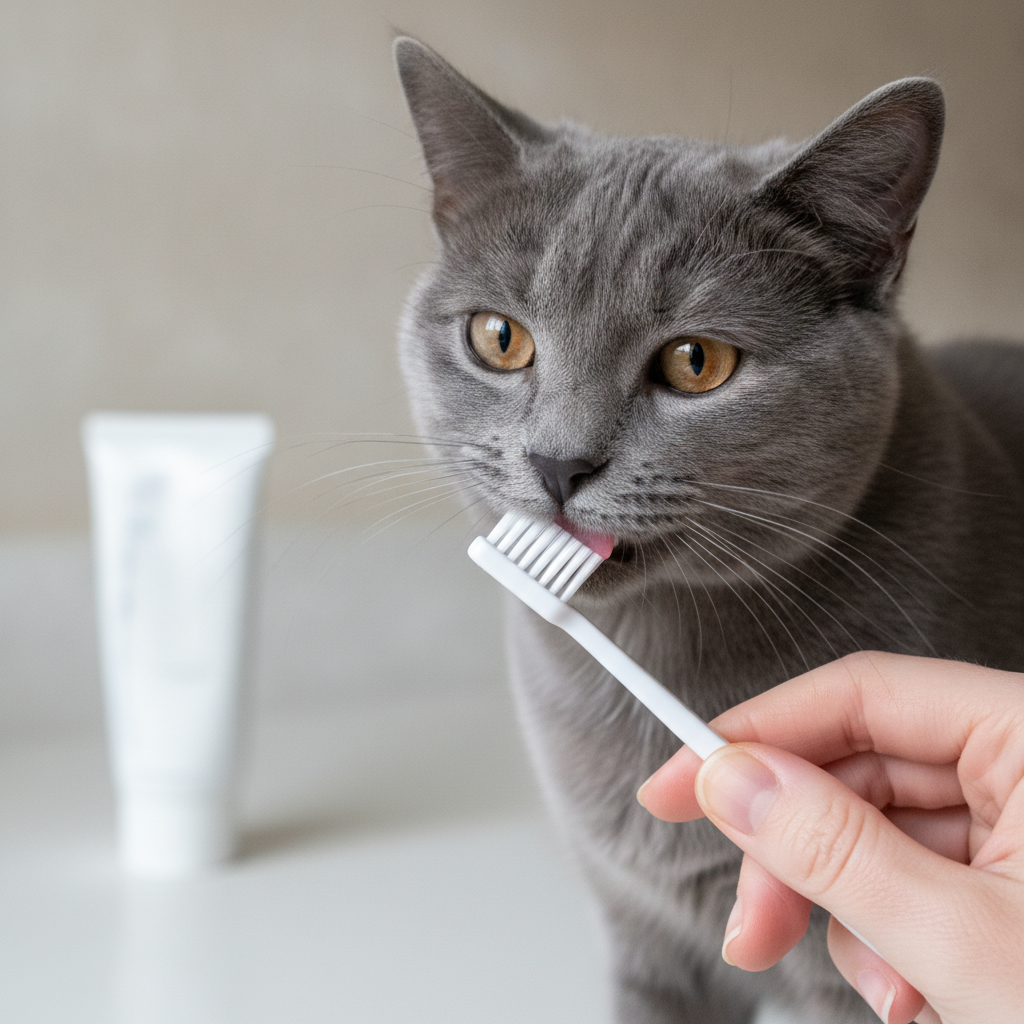
Gather a cat-specific toothpaste and a small brush. A cat toothbrush or a baby toothbrush works; there are also over-the-finger brushes that give more control, though use caution because a cat can bite through them. When you’re just starting, a cotton swab is fine for practicing the motions. Choose whatever fits comfortably in your cat’s mouth. And a firm line: human toothpaste is off-limits, since it’s designed to be spit out and may include things that poison cats. DIY remedies like baking soda and coconut oil don’t belong here either.
The one shortcut that makes it doable
Here’s a detail that removes half the difficulty: you only need to clean the outer surfaces of the teeth, the sides that touch the cheeks. Salivary enzymes and periodic professional cleanings take care of the inner surfaces. So you can forget about wrestling access to the tongue side of your cat’s mouth entirely. Start with the large canine teeth, which are easiest to reach, then work back to the bigger cheek teeth, using gentle circular motions.
When brushing just isn’t happening
If you and your cat have hit the limit of what’s tolerable, you’re in good company, and the important thing is not to give up on dental care altogether. Mechanical brushing is the best way to control plaque at home, but real alternatives exist: dental diets, dental treats, water additives, dental wipes, oral sprays and gels, and anti-plaque powders. The key to sorting the effective from the useless is the Veterinary Oral Health Council (VOHC) seal, awarded to products scientifically shown to reduce plaque or tartar. Get suggestions from your vet, favor anything carrying that seal, and expect some trial and error before you land on something your cat accepts.
Know the diseases you’re preventing
Understanding what’s at stake helps. The most common feline dental problems include:
- Gingivitis: Red, swollen gums, the earliest and still-reversible stage of periodontal disease.
- Periodontal disease: Infection and inflammation of the structures that hold each tooth in place.
- Tooth resorption: The tooth’s hard tissue slowly breaks down and erodes, eventually causing tooth loss. It’s frequently hidden and quite painful.
- Stomatitis: Severe inflammation across the mouth’s soft tissues, gums, tongue, and palate. Viral infections like feline herpesvirus, calicivirus, FIV, and FeLV can contribute.
Routine care means exams and professional cleanings even when everything looks fine, because you want to protect the mouth before your cat ever feels discomfort. Watch for the warning signs, sudden bad breath, dropping food, reluctance to eat, teeth chattering, oral discharge, facial swelling, pawing at the face, drooling, gagging, or a newly touch-shy cat, and get those checked promptly.
What newer research adds
One of these conditions deserves special attention, because it’s far more common than most owners realize: tooth resorption. Studies estimate it affects somewhere between roughly a quarter and two-thirds of all cats depending on the population, and close to three-quarters of cats aged five and older. It’s a leading reason cats need teeth extracted, and it can be genuinely painful while hiding in plain sight.
The reason it hides points to why professional care can’t be replaced by brushing alone. Research consistently finds that dental X-rays reveal far more resorption than a visual exam catches, in some studies detecting well over twice as many affected teeth, and turning up hidden lesions in roughly half the cases where nothing looked wrong to the naked eye. That’s the argument for pairing your home brushing with regular veterinary dental exams: brushing controls the plaque you can reach, but only your vet, with X-rays and a cleaning under anesthesia, can find and treat the painful problems developing below the surface.
References
- Reiter, A. M., and Mendoza, K. A. “Feline dental resorptive lesions: an unsolved enigma in veterinary dentistry.” Veterinary Clinics of North America: Small Animal Practice, 2002.
- American Animal Hospital Association. “2019 AAHA Dental Care Guidelines for Dogs and Cats.” aaha.org.
- Cornell Feline Health Center. “Tooth Resorption.” Cornell University College of Veterinary Medicine, vet.cornell.edu.
- World Small Animal Veterinary Association. “Global Dental Guidelines.” wsava.org.
This article is for general education and does not replace veterinary care. If your cat shows signs of dental pain or disease, see your veterinarian.